Taste has
an address.
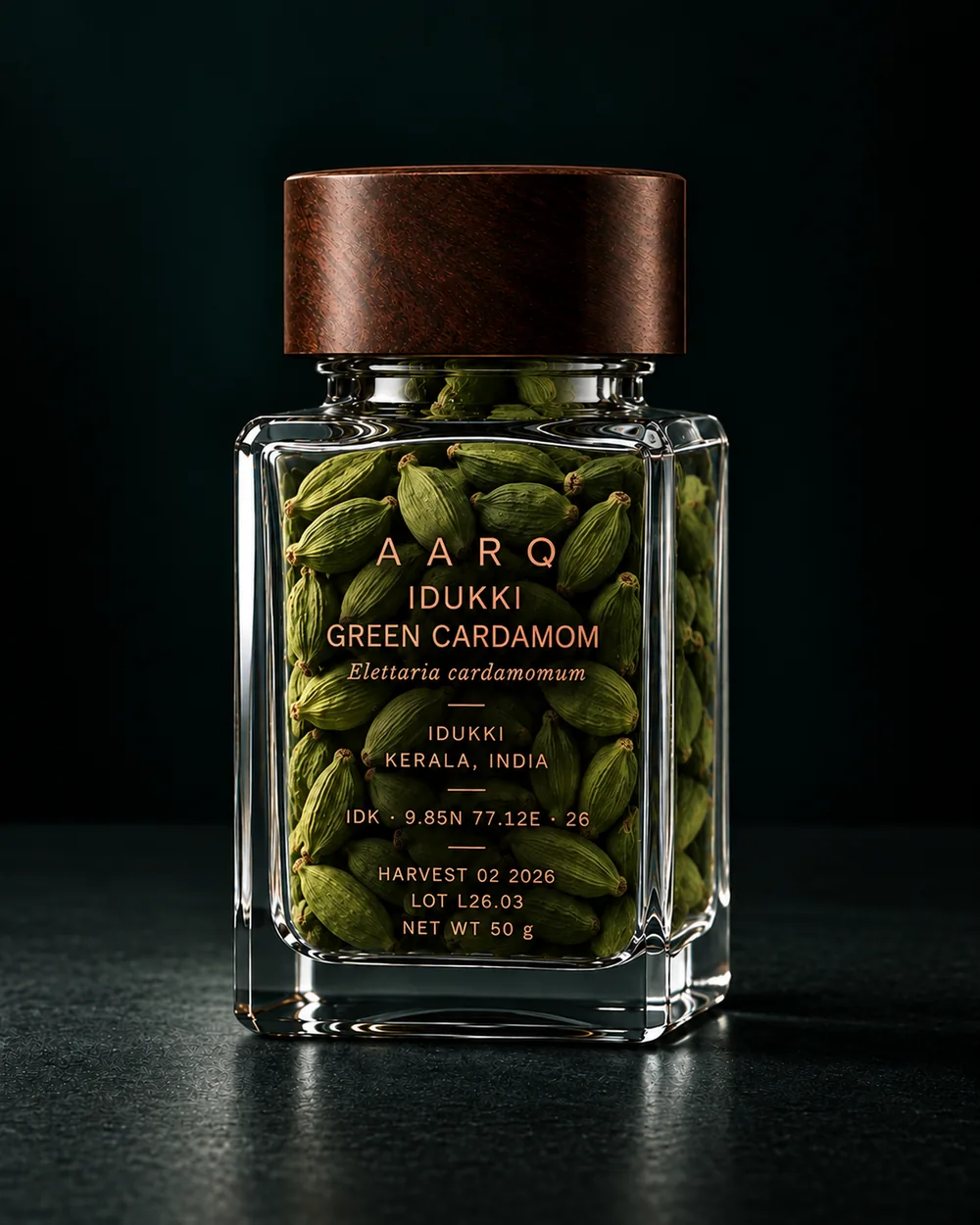
Idukki, Kerala9.85N 77.12E
IDK · 9.85N 77.12E · 26One place. One harvest. One numbered lot.
Whole pods · Harvest 02.2026Still green. That is how you know nobody rushed the curing.
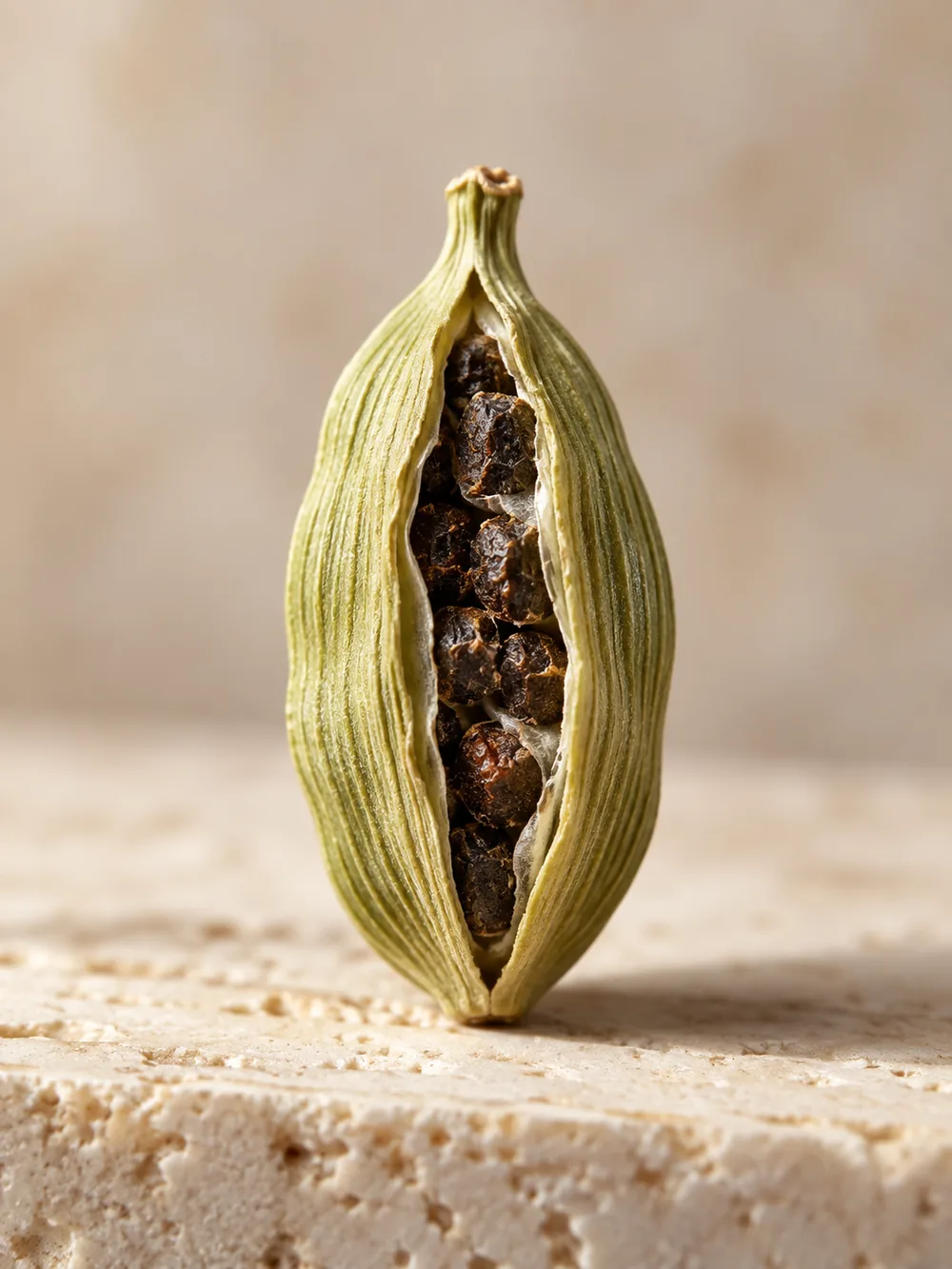
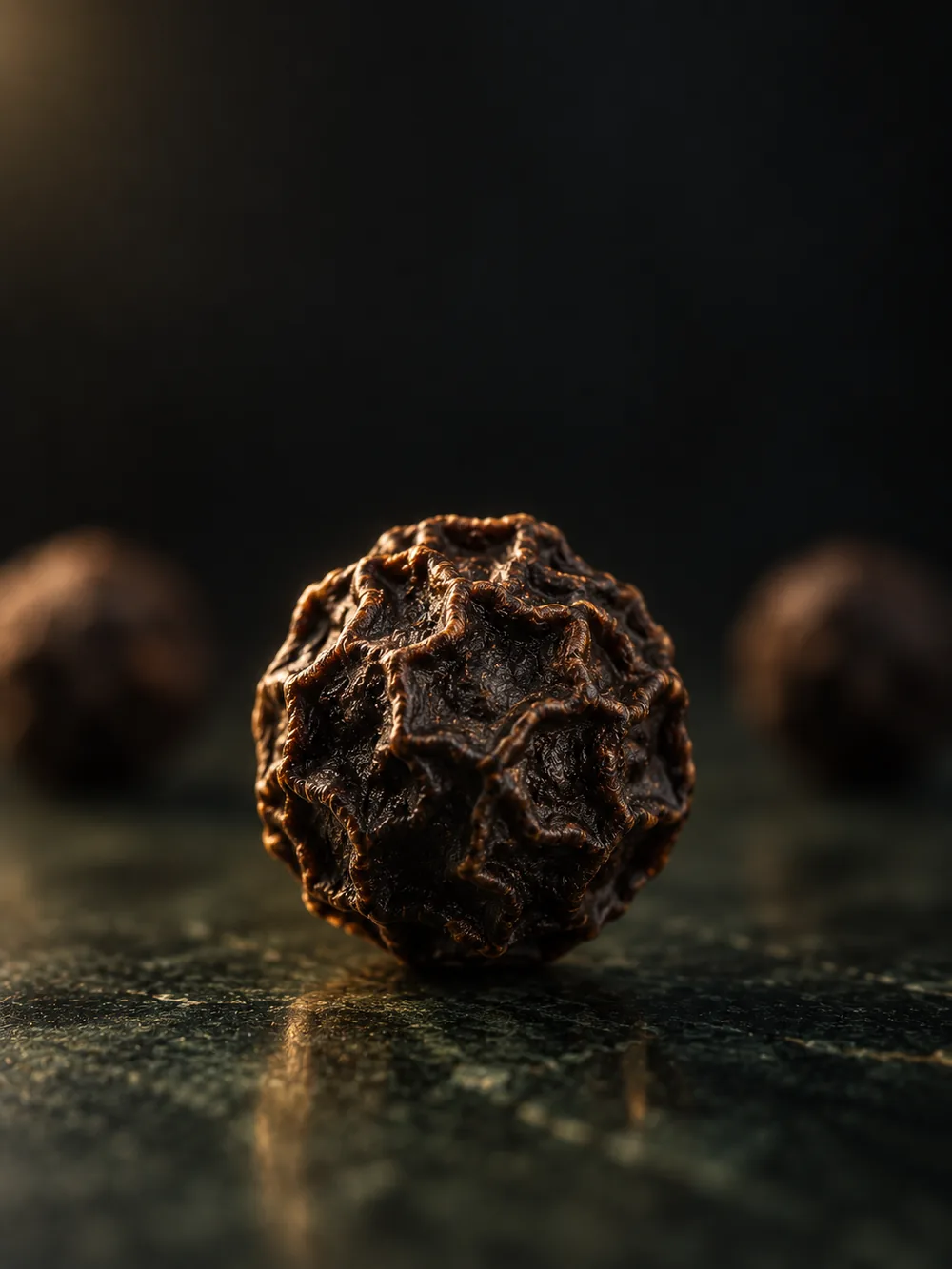
One pod, chosen from the lotIt is about to open. Inside: black, sticky, loud.
Green Cardamom
Elettaria cardamomum
- Origin
- Idukki, Kerala · 9.85N 77.12E
- Harvest
- 02.2026
Arrives as a gift. Stays as an heirloom.
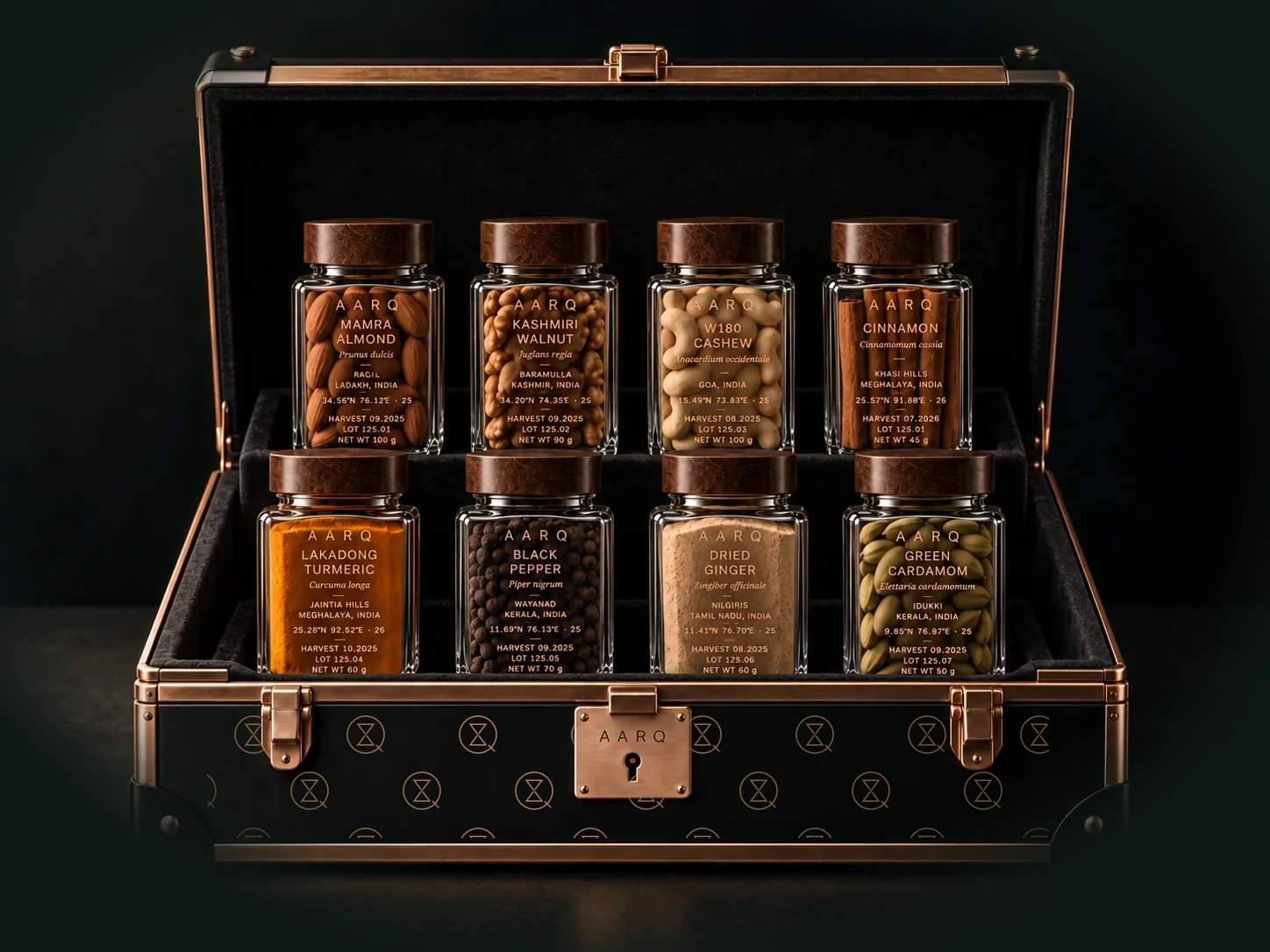
AARQ pine, light pine green or brushed silver panels in a rose-gold, silver or black aluminium frame, with rose-gold, satin silver or black hardware and one leather handle. Eight jars inside, each from one named place, one harvest and one numbered lot.
372 × 206 × 131 mmHeld top and bottom.
Each jar stands 30 mm deep in flocked foam, and the lid closes onto its cap, so nothing moves in transit. Lift the tray out and the case is yours to keep; the jars are made to be refilled.
- Lakadong Turmeric90 g
- Kashmiri Walnut100 g
- Black Pepper80 g
- Cashew W180100 g
- Green Cardamom50 g
- Mamra Almond100 g
- Dried Ginger80 g
- Cassia Bark45 g
Put a name on it.
Made in limited numbers for Diwali 2026. Engraved plates and company editions by arrangement.
Eight places. One of each.
Five spices. Three dry fruits. Each from one named place, one harvest and one numbered lot, sealed in clear glass so you can see exactly what you are getting.
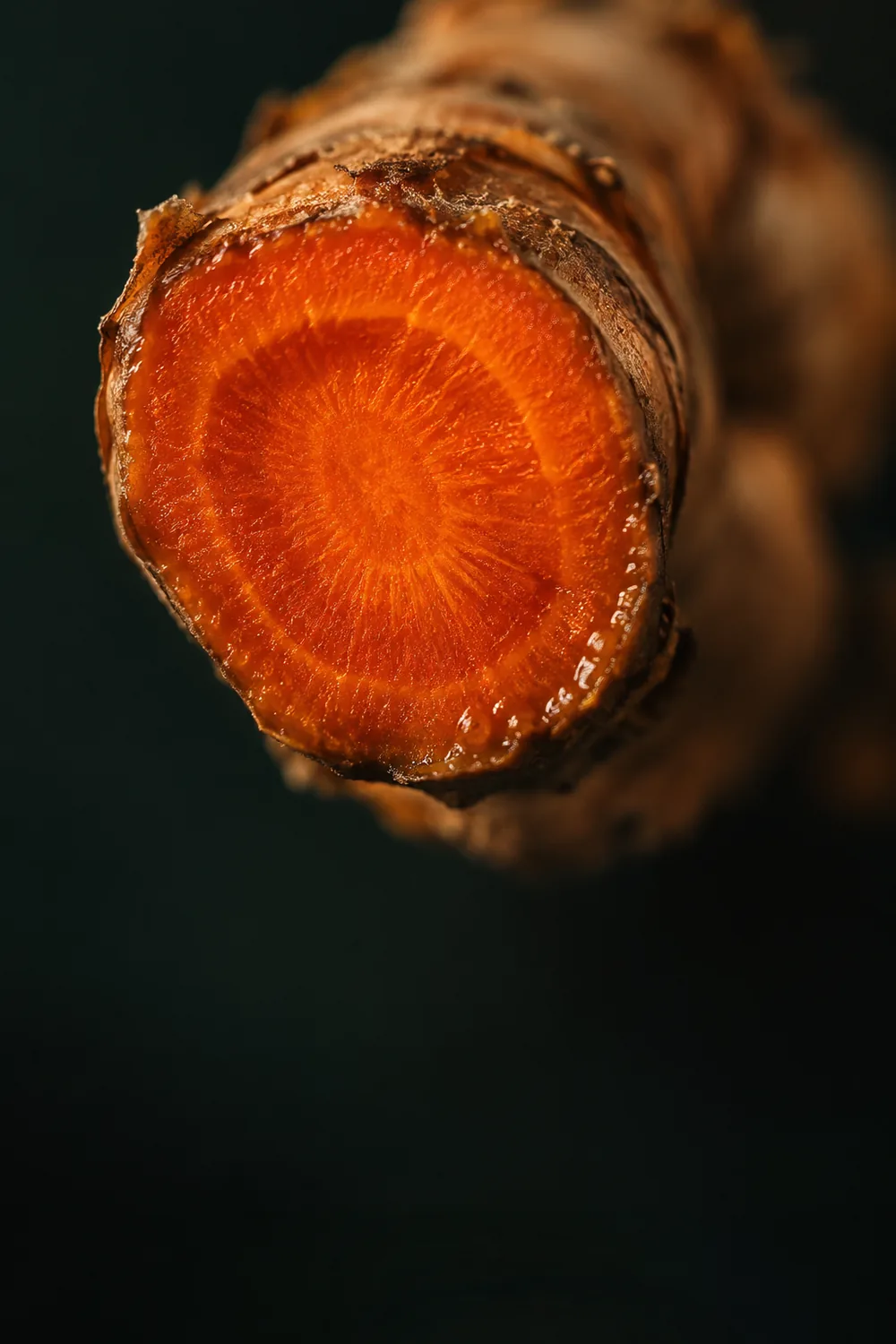 Turmeric
Lakadong TurmericJaintia Hills, Meghalaya
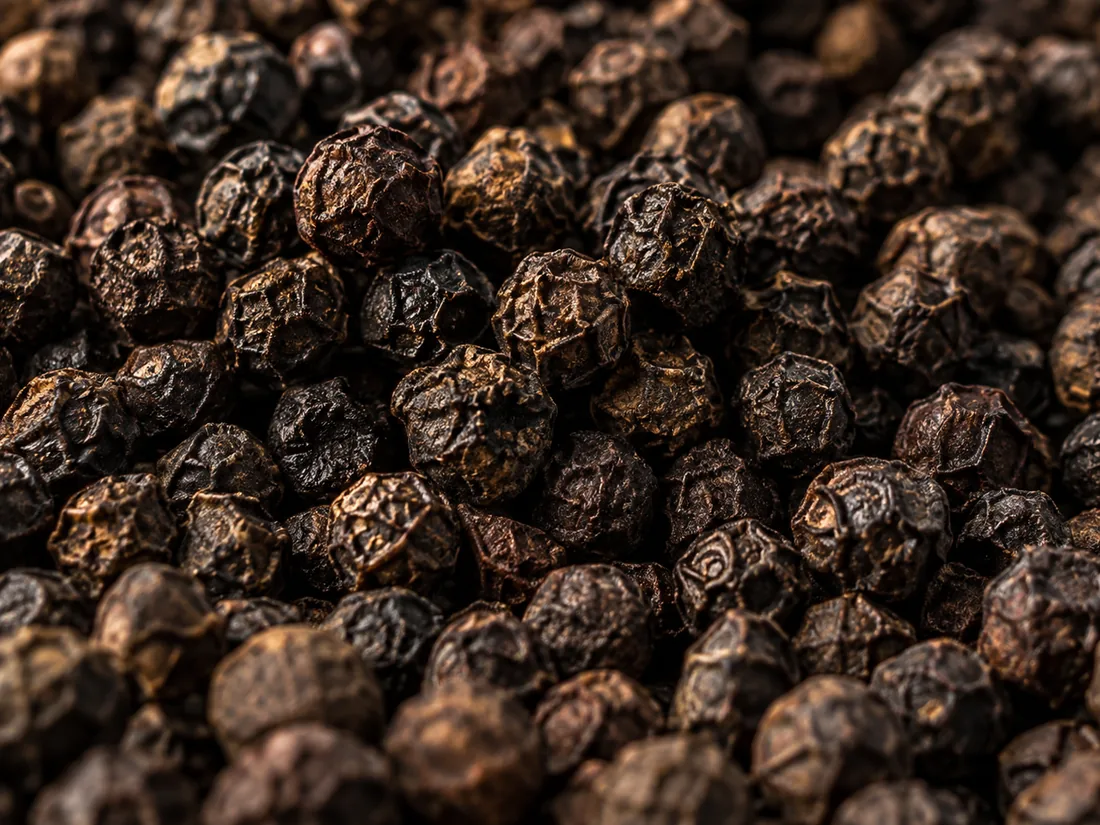 Pepper
Black PepperWayanad, Kerala
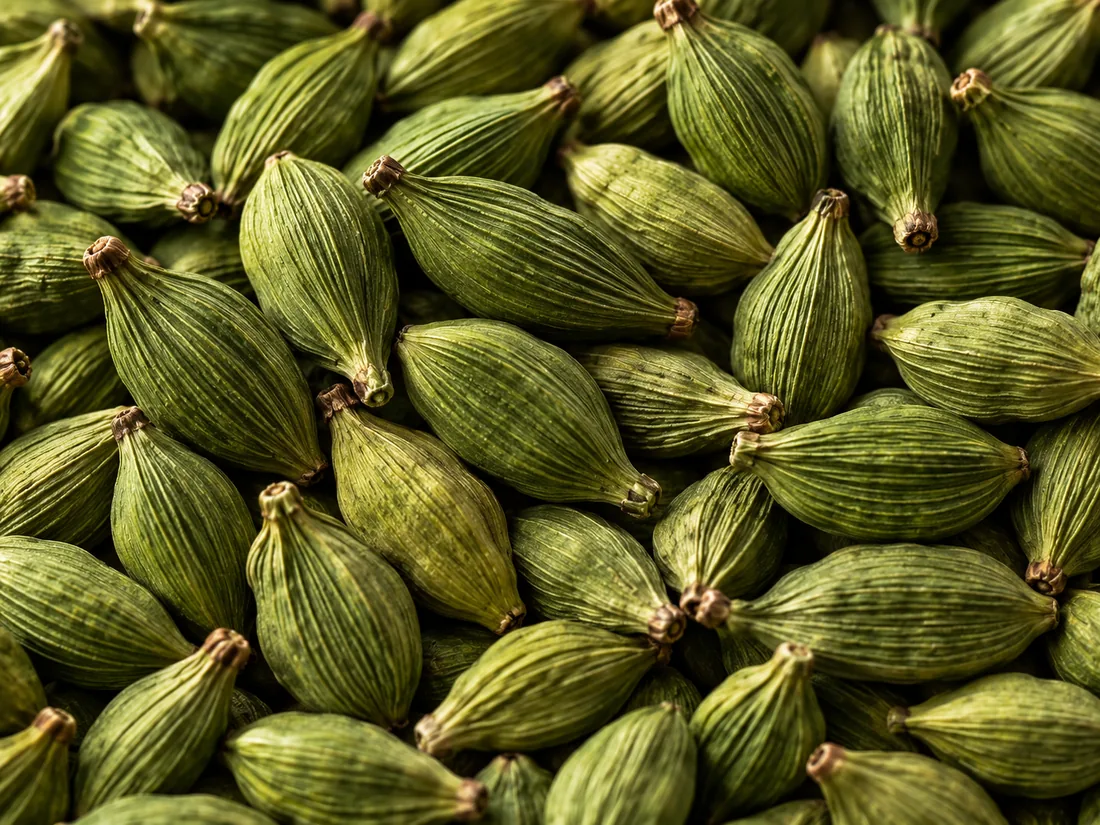 Cardamom
Green CardamomIdukki, Kerala
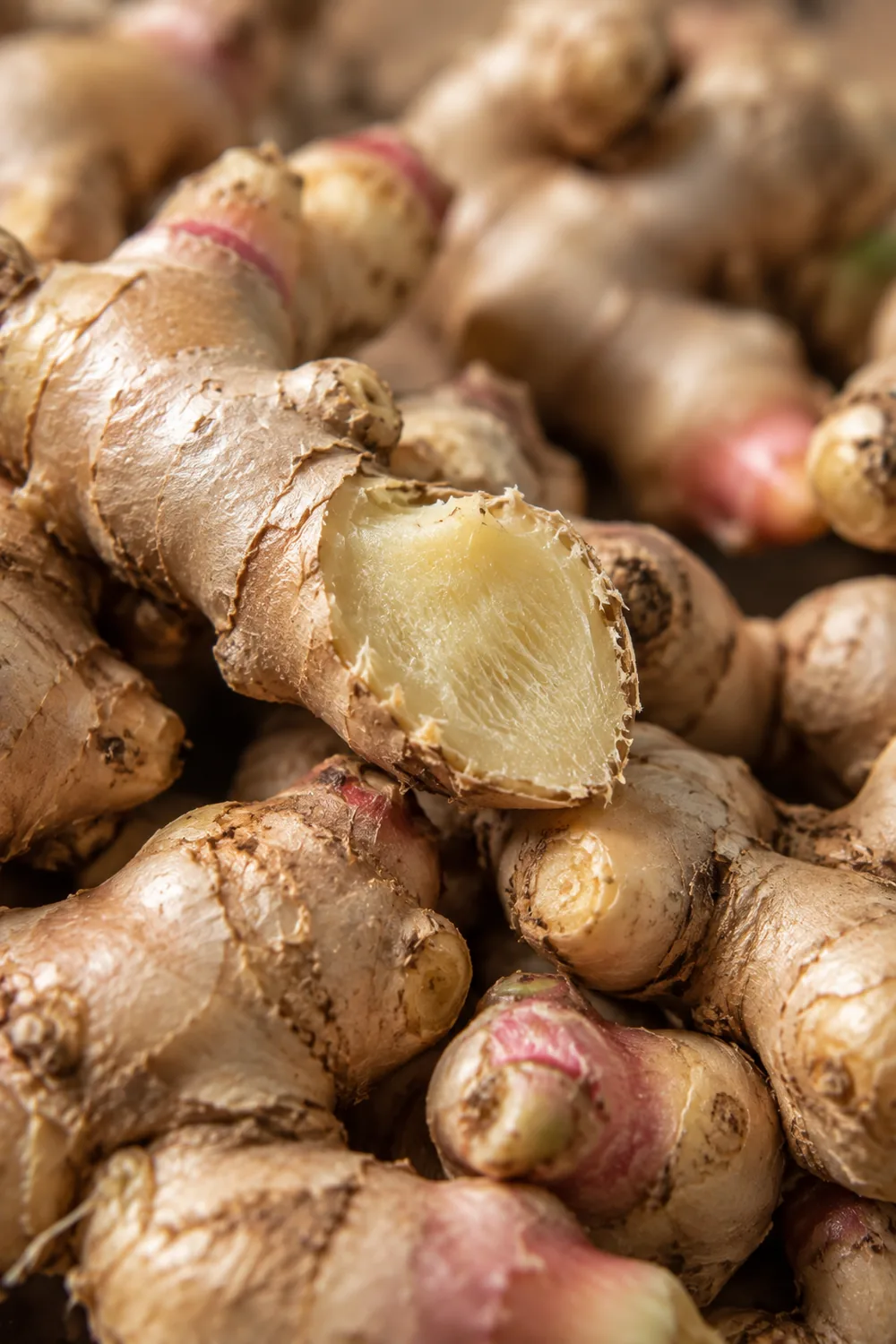 Ginger
Dried GingerPeermade, Idukki, Kerala
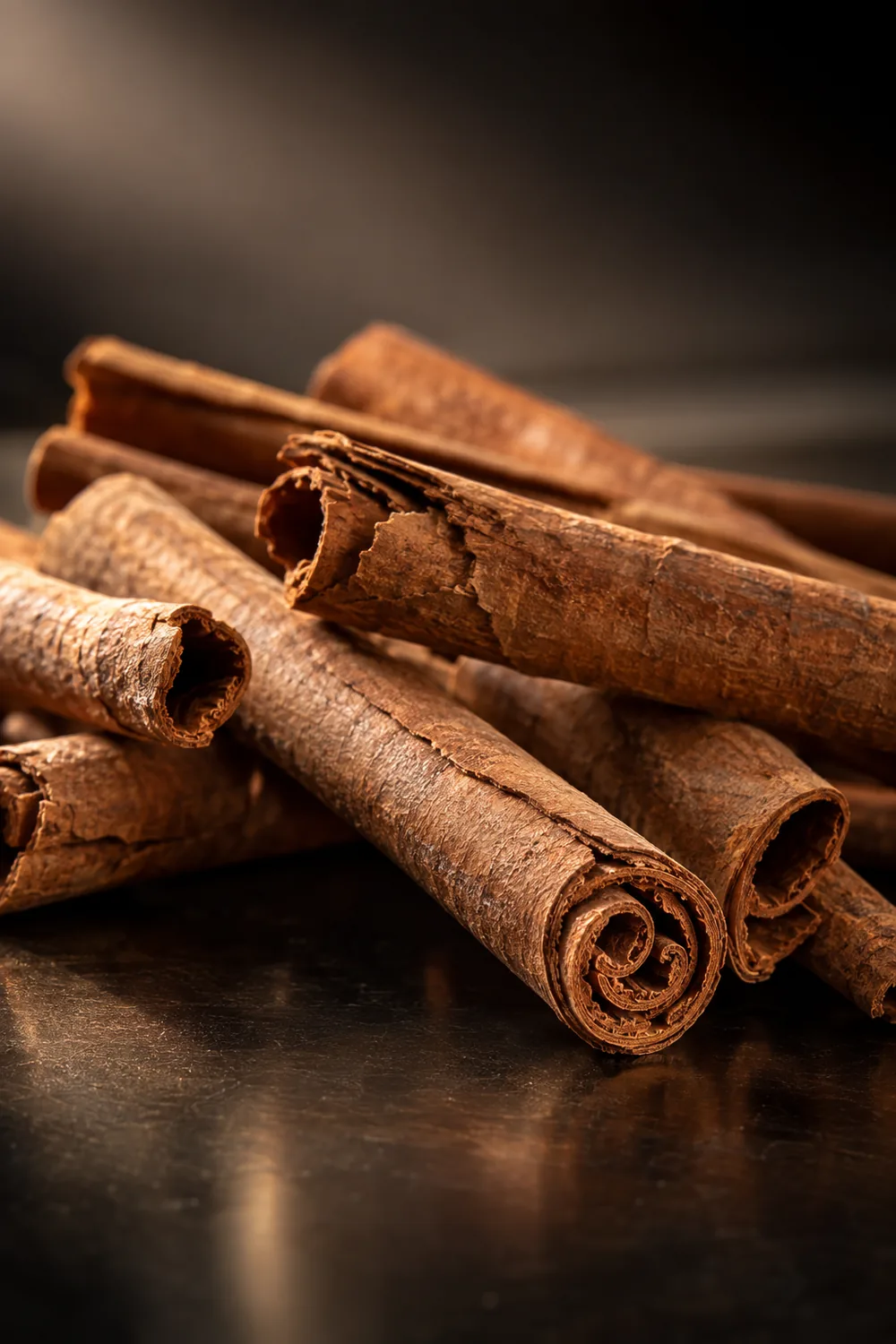 Cassia
 BarkKhasi Hills, Meghalaya
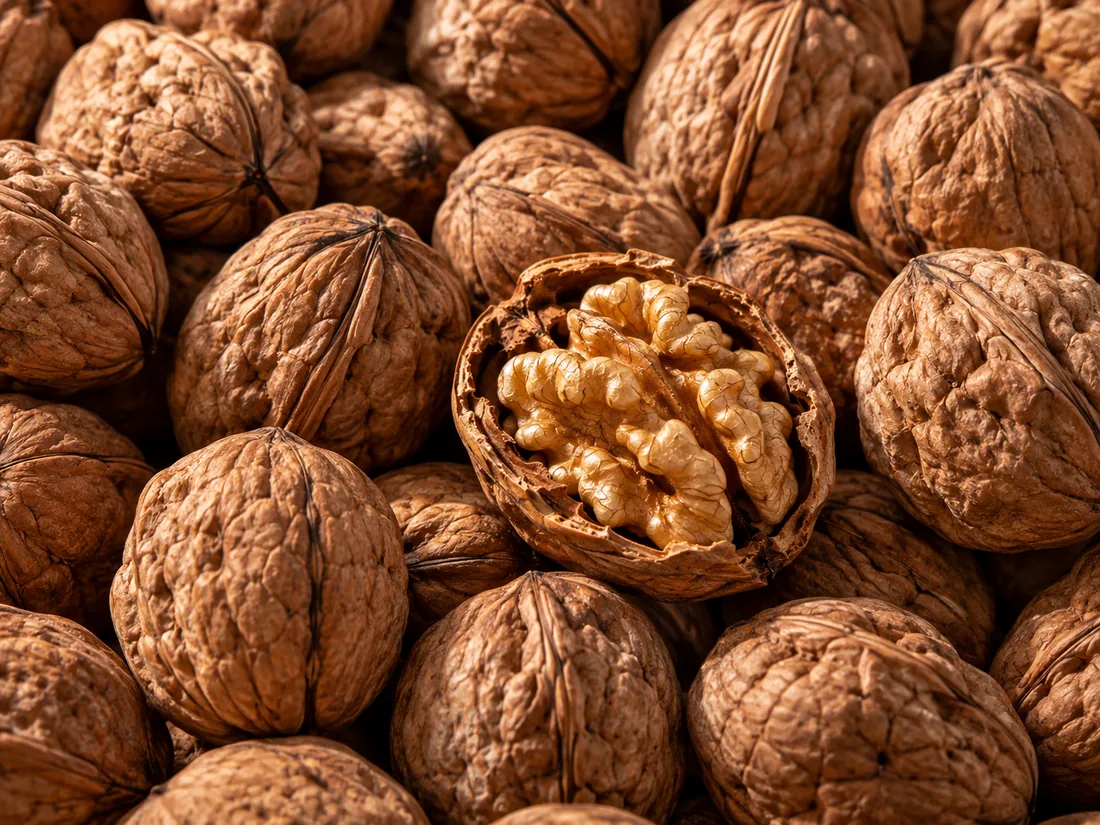 Walnut
Kashmiri WalnutKashmir Valley, Jammu & Kashmir
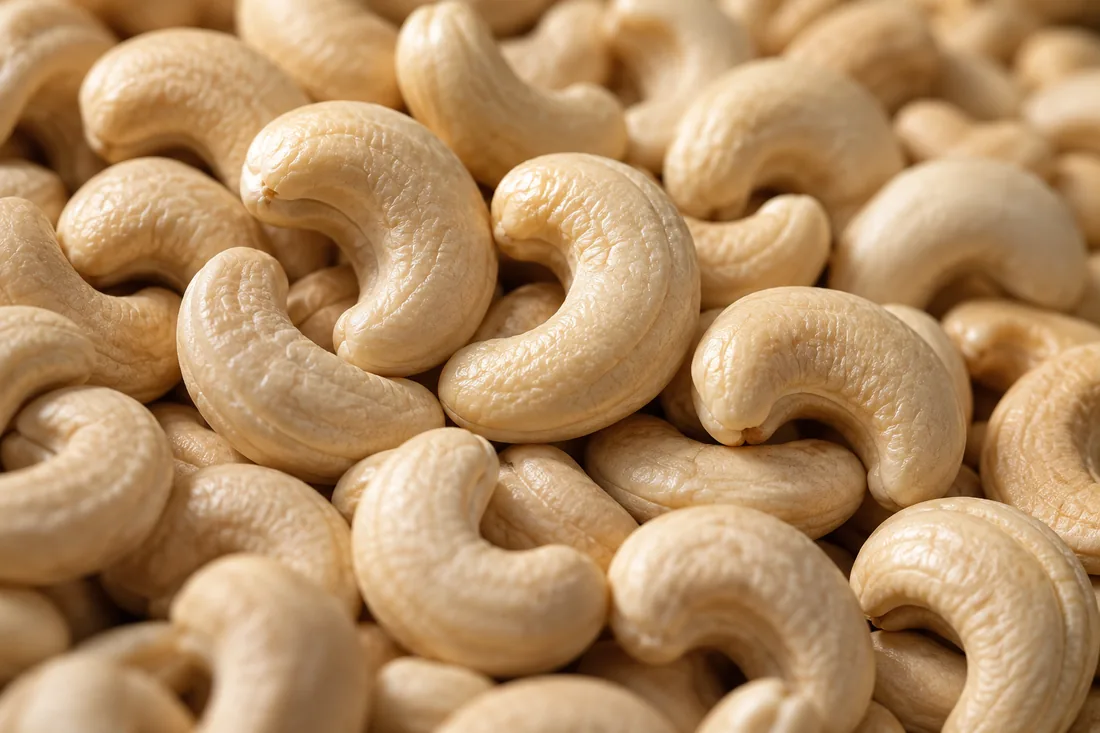 Cashew
 W180Goa
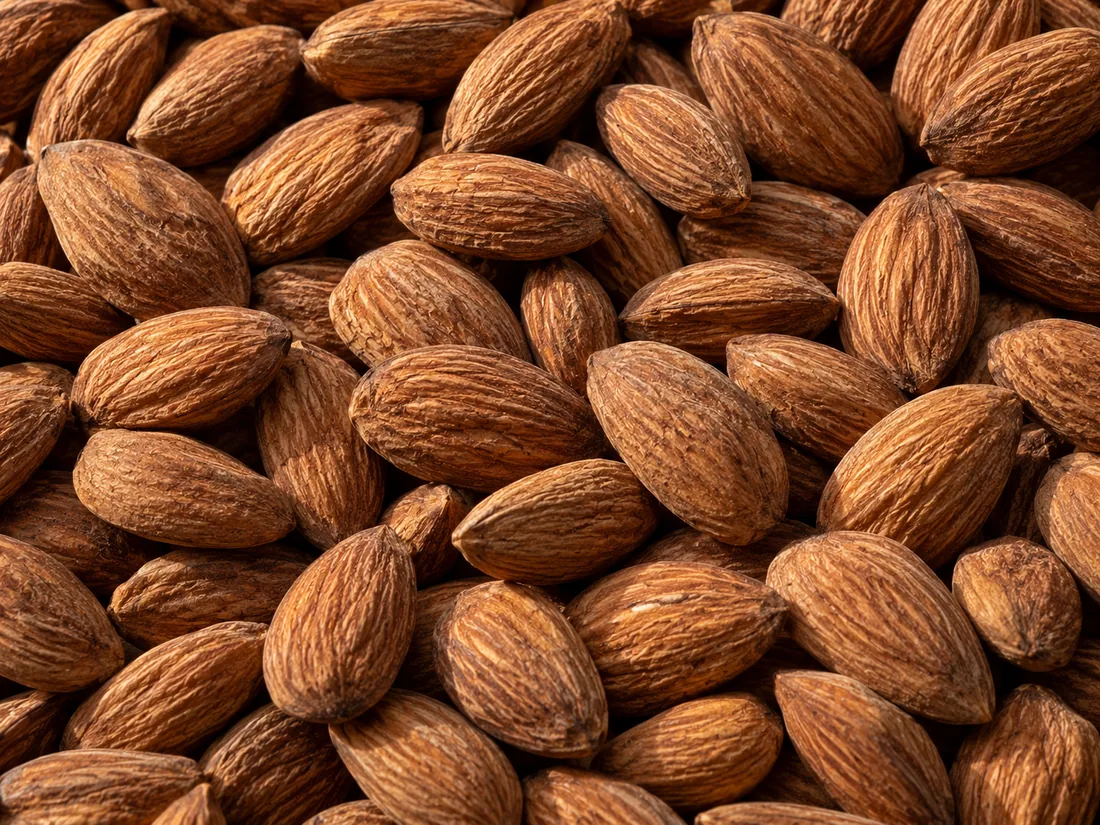 Almond
Mamra AlmondMamra grade · packed at Samba, J&K
Most spice travels anonymously. Blended across farms, years and countries until it tastes of nowhere in particular. We do the opposite.
One origin in every jar. The harvest month printed on the front. A lot number that leads back to a real place and a real season. Nothing blended to hit a price, nothing ground until it has to be.
And clear glass, always. Turmeric the colour of a low sun, cardamom still green, pepper black as wet slate. An ingredient this good has no reason to hide behind a label.
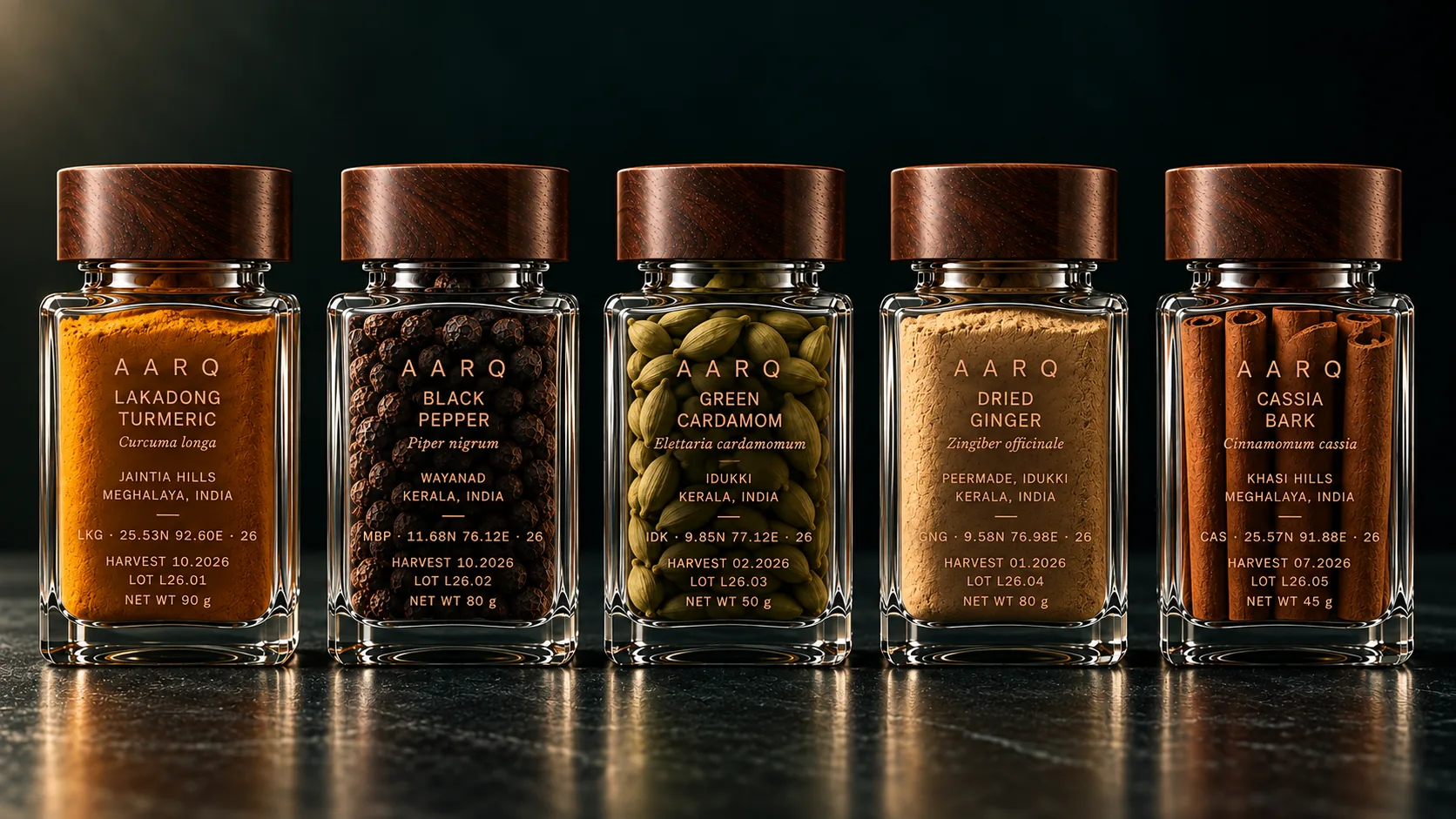
The jar never changes. The contents do the talking.
Eight ingredients, one square of heavy glass. The same cap, the same copper type, the same quiet label. The only colour on the shelf comes from what is inside.
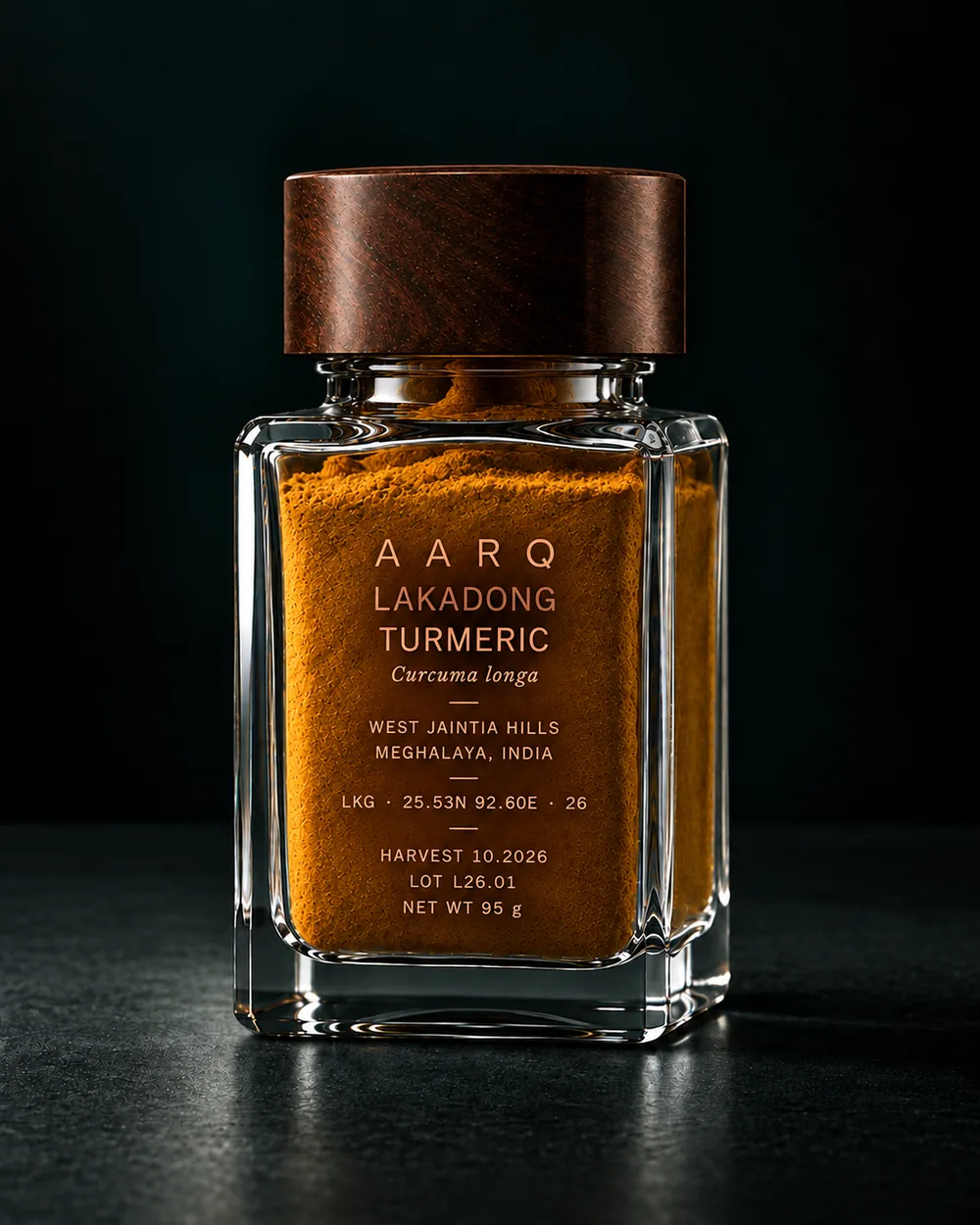
Lakadong Turmeric
The colour of a low sun.
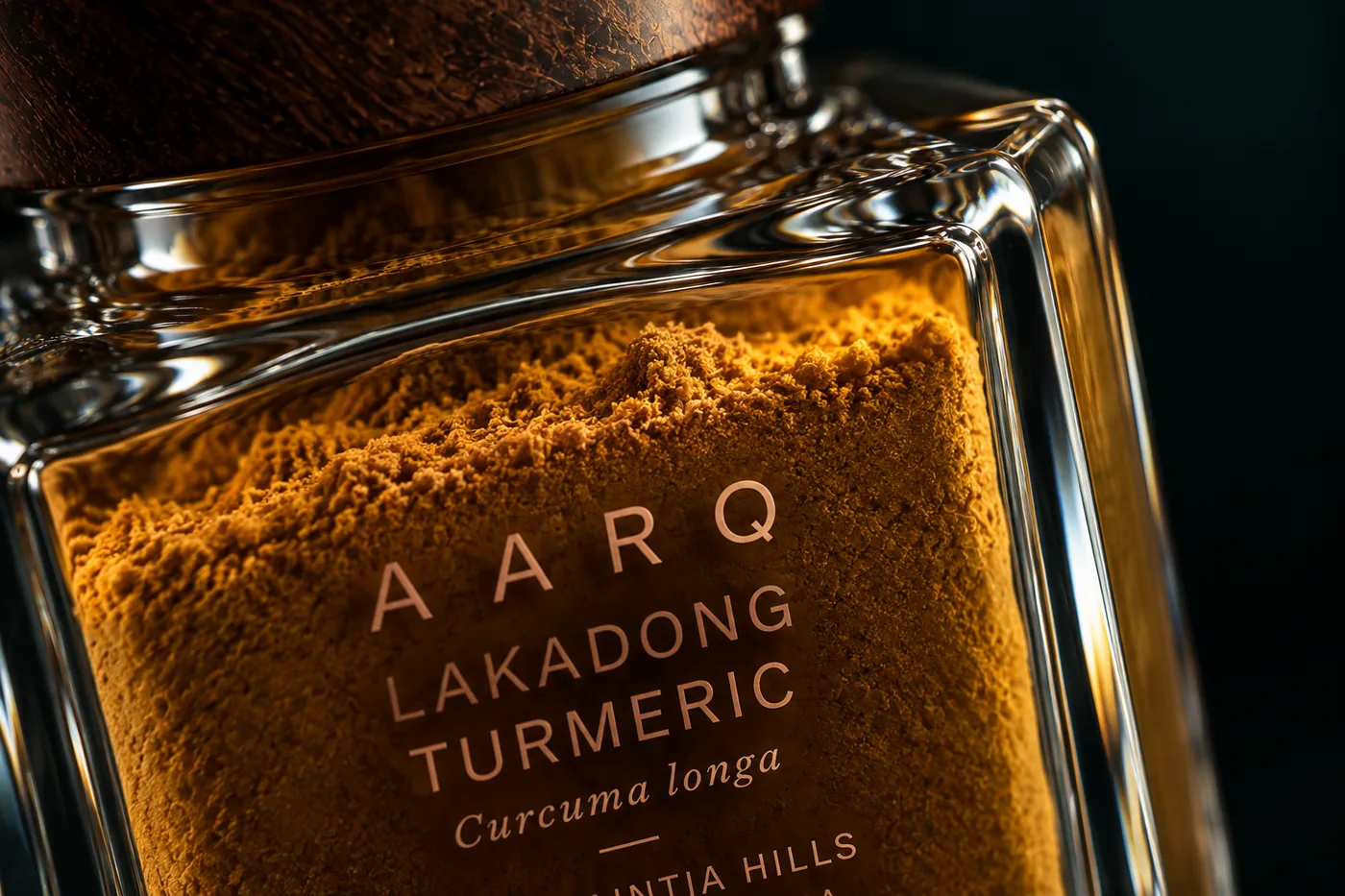
Grown on the wet, red slopes of the Jaintia Hills, where the rain rarely stops and the rhizomes stay small, dense and fiercely orange. Milled fine, it smells of warm earth, orange peel and a flicker of white pepper. Half a teaspoon turns a pan of ghee the colour of late afternoon.
- Origin
- Jaintia Hills, Meghalaya
- Harvest
- 10.2026
- Form
- Ground
- Net weight
- 90 g
- On the nose
- Warm earth · orange zest · white pepper
Bloom it in ghee for twenty seconds before anything else enters the pan.
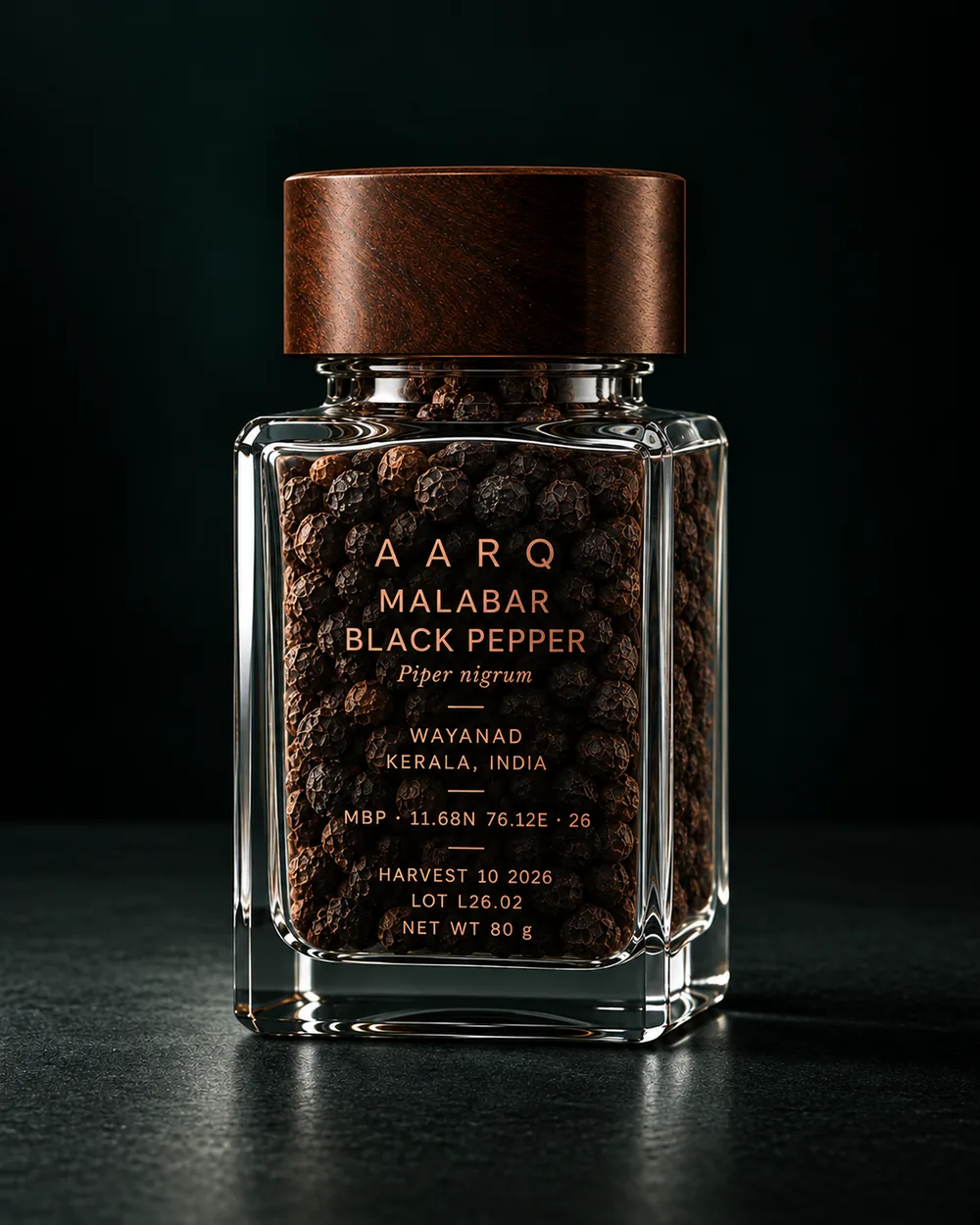
Black Pepper
Heat that arrives late and stays.
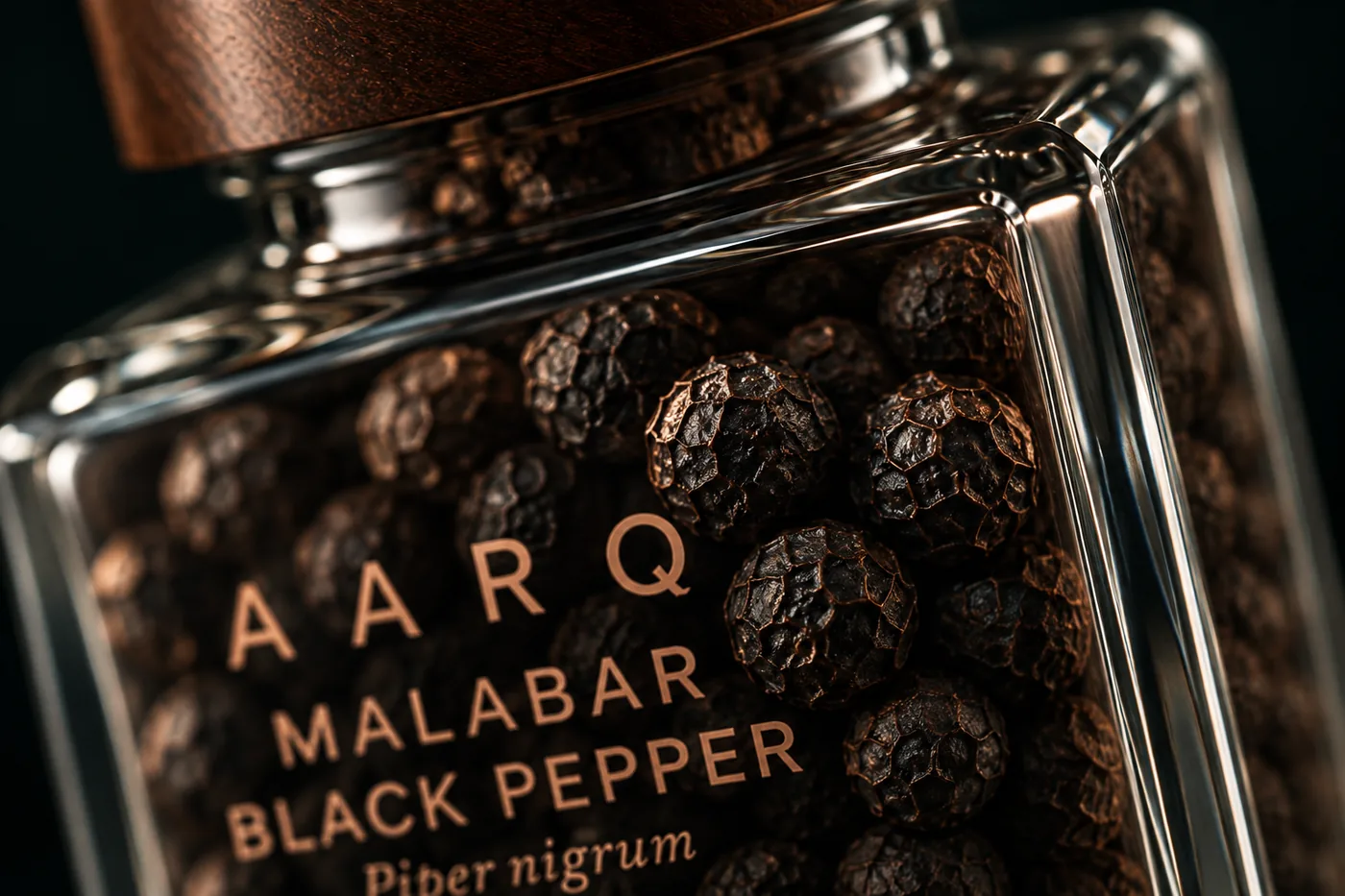
Berries from Wayanad’s forest-shaded gardens, left on the vine until they are heavy, then sun-dried until the skins wrinkle tight and black. Crack one between your fingers: pine resin first, then lemon pith, then a slow warmth that gathers at the back of the throat. Ground pepper forgets all of this within weeks. Whole berries do not.
- Origin
- Wayanad, Kerala
- Harvest
- 10.2026
- Form
- Whole
- Net weight
- 80 g
- On the nose
- Pine resin · lemon pith · dark wood
Crack it coarse over a fried egg, a ripe mango, or vanilla ice cream. Trust us on the last one.
Green Cardamom
Cold, green and almost sweet.
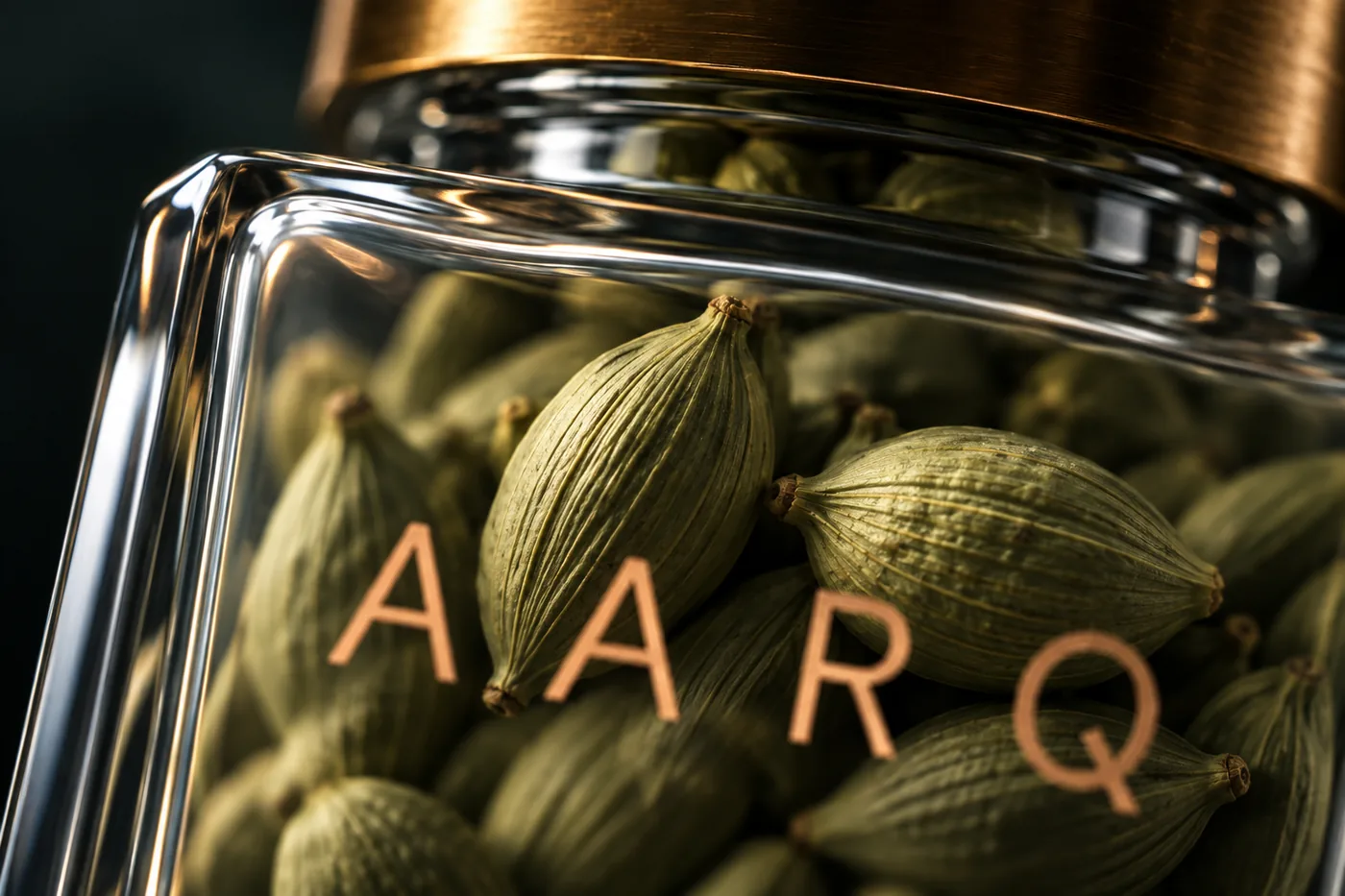
Hand-picked in the cardamom hills of Idukki and cured slowly so the pods keep their green. Split one open and the seeds are black, sticky and loud: eucalyptus, mint, a lift of lemon. One pod perfumes a whole pot of rice. Four will take it over. It is the most generous spice in the case, so go gently.
- Origin
- Idukki, Kerala
- Harvest
- 02.2026
- Form
- Whole pods
- Net weight
- 50 g
- On the nose
- Eucalyptus · mint · sweet lemon
Crush a single pod into your coffee grounds before you brew.
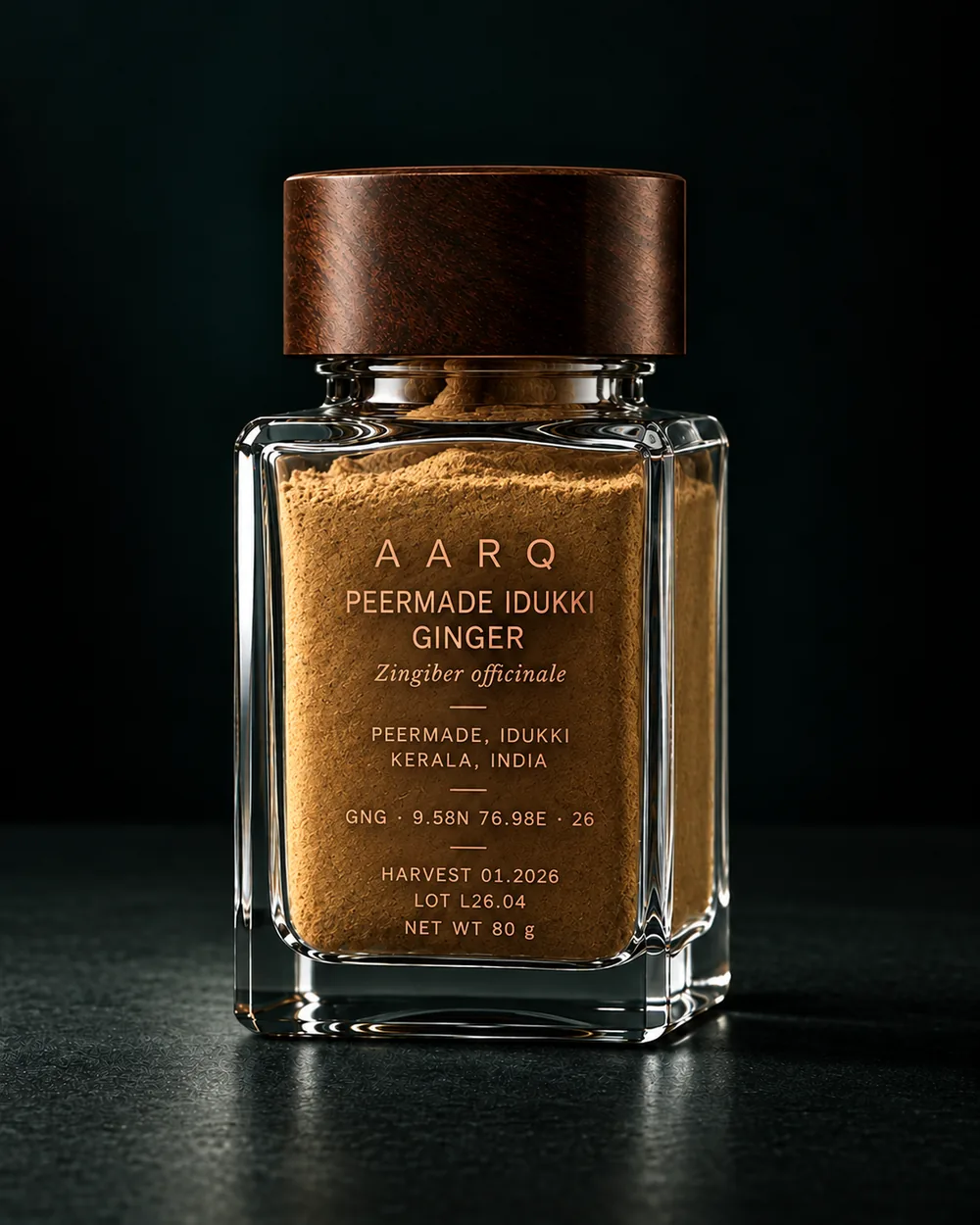
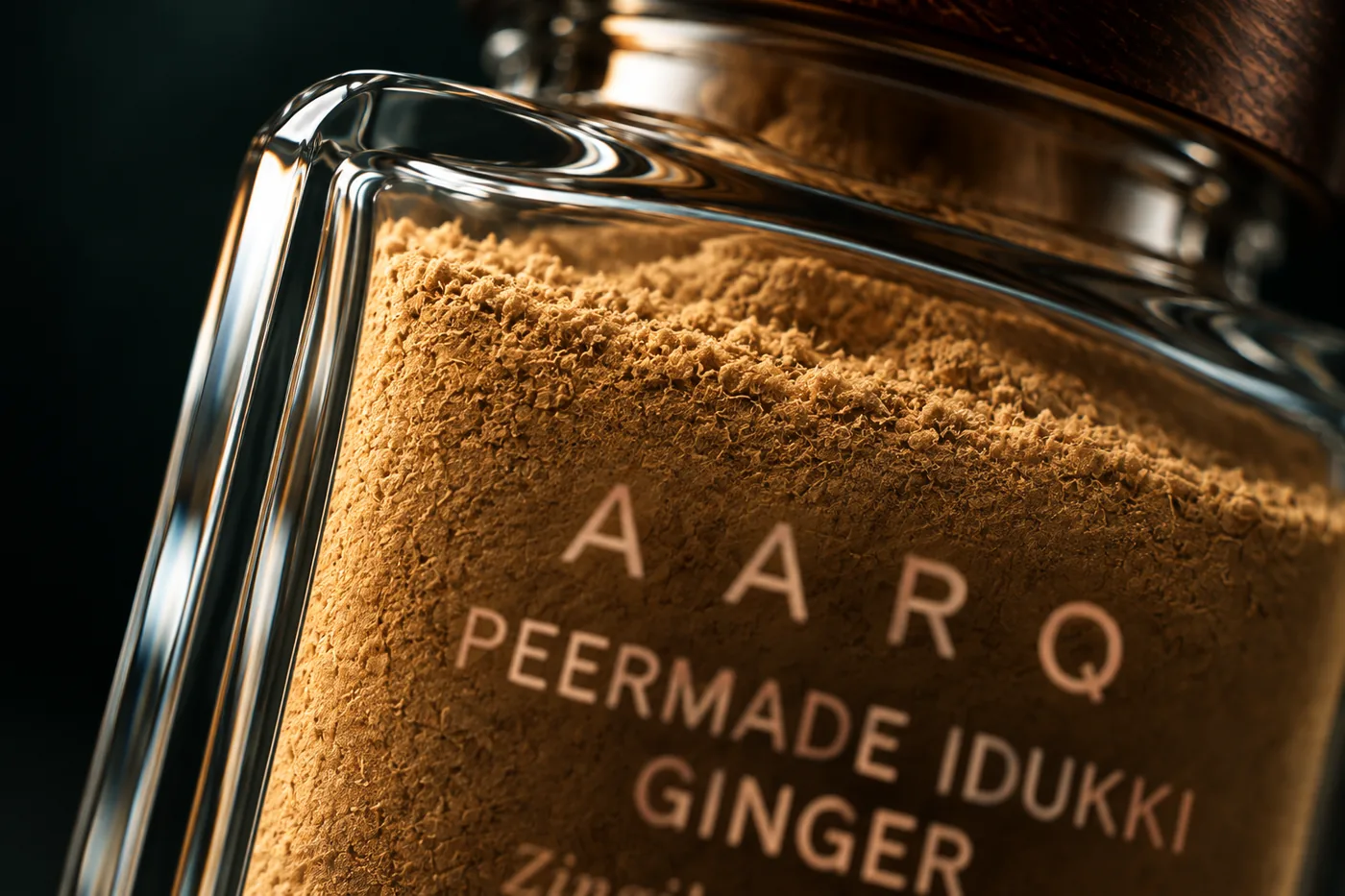
Dried Ginger
A slow burn, not a sting.
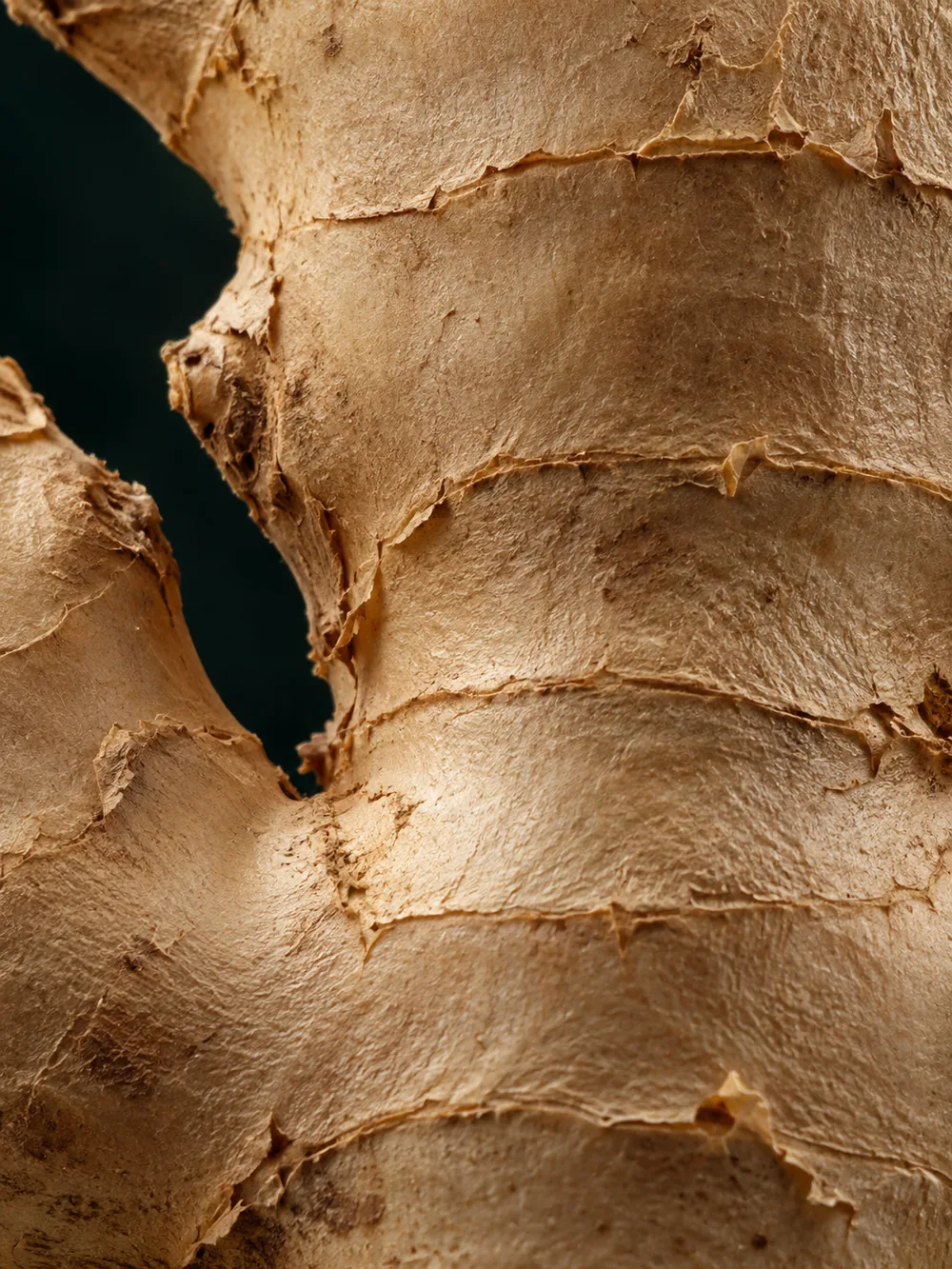
Fresh ginger shouts. Dried ginger hums. Peeled, sun-dried and milled, Peermade ginger trades its sharp juice for something deeper and rounder: lemon rind, dry hay, a long clean heat that warms rather than bites. It is the quiet backbone of chai masala, of gingerbread, and of half the subcontinent’s winter cooking.
- Origin
- Peermade, Idukki, Kerala
- Harvest
- 01.2026
- Form
- Ground
- Net weight
- 80 g
- On the nose
- Lemon rind · dry hay · clean heat
A pinch in hot milk with a little jaggery. That is the whole recipe.
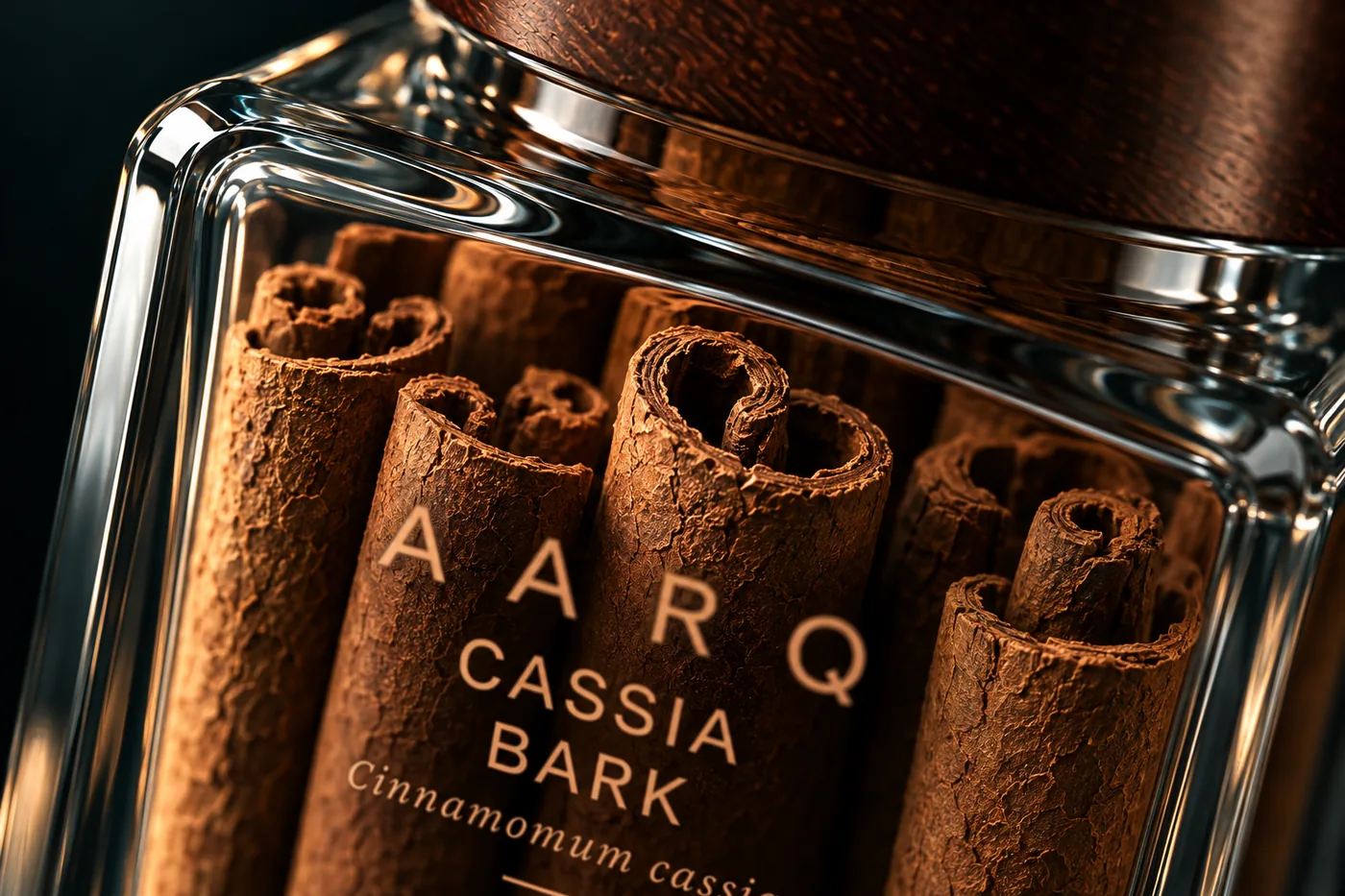
Cassia Bark
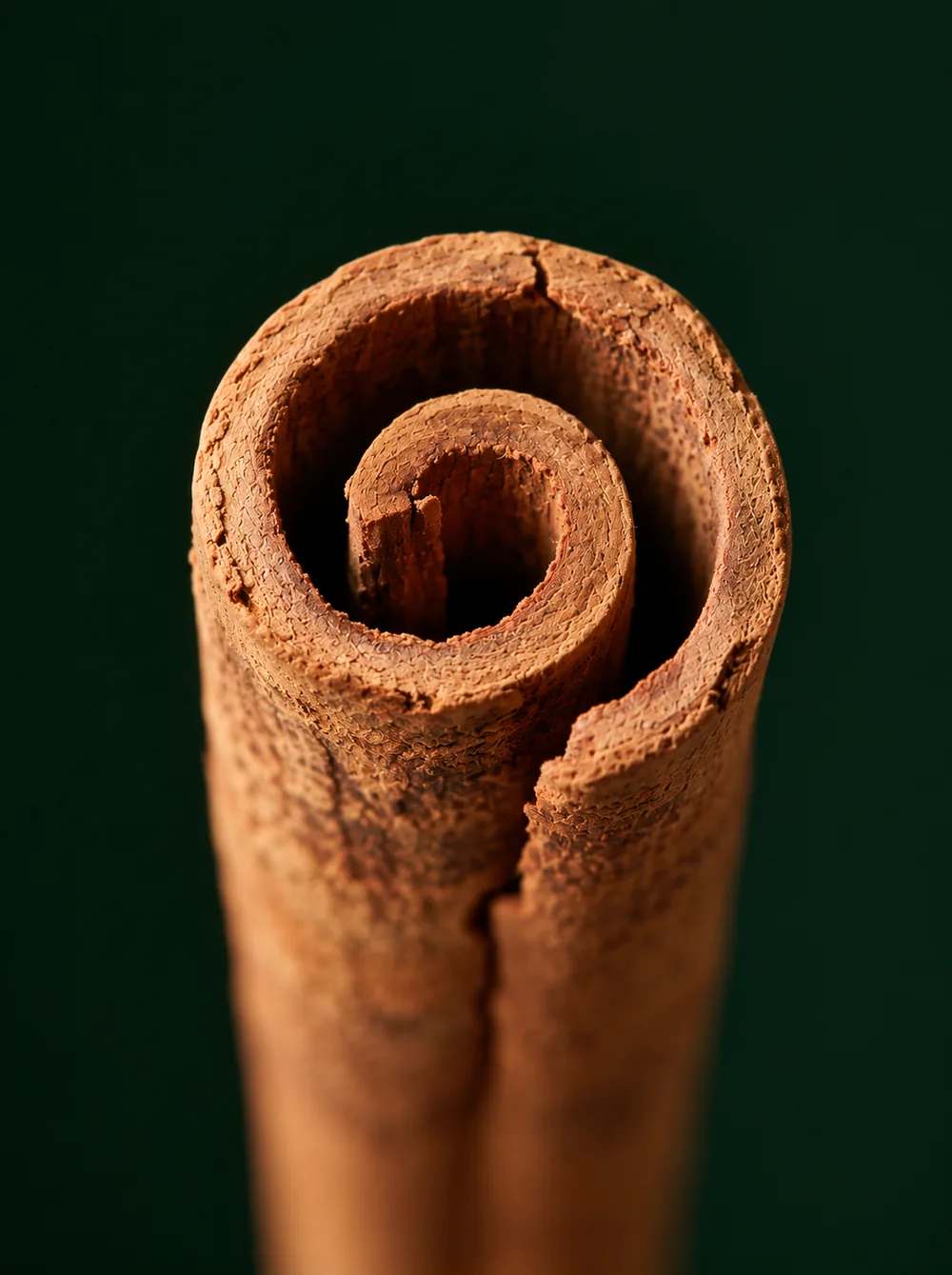
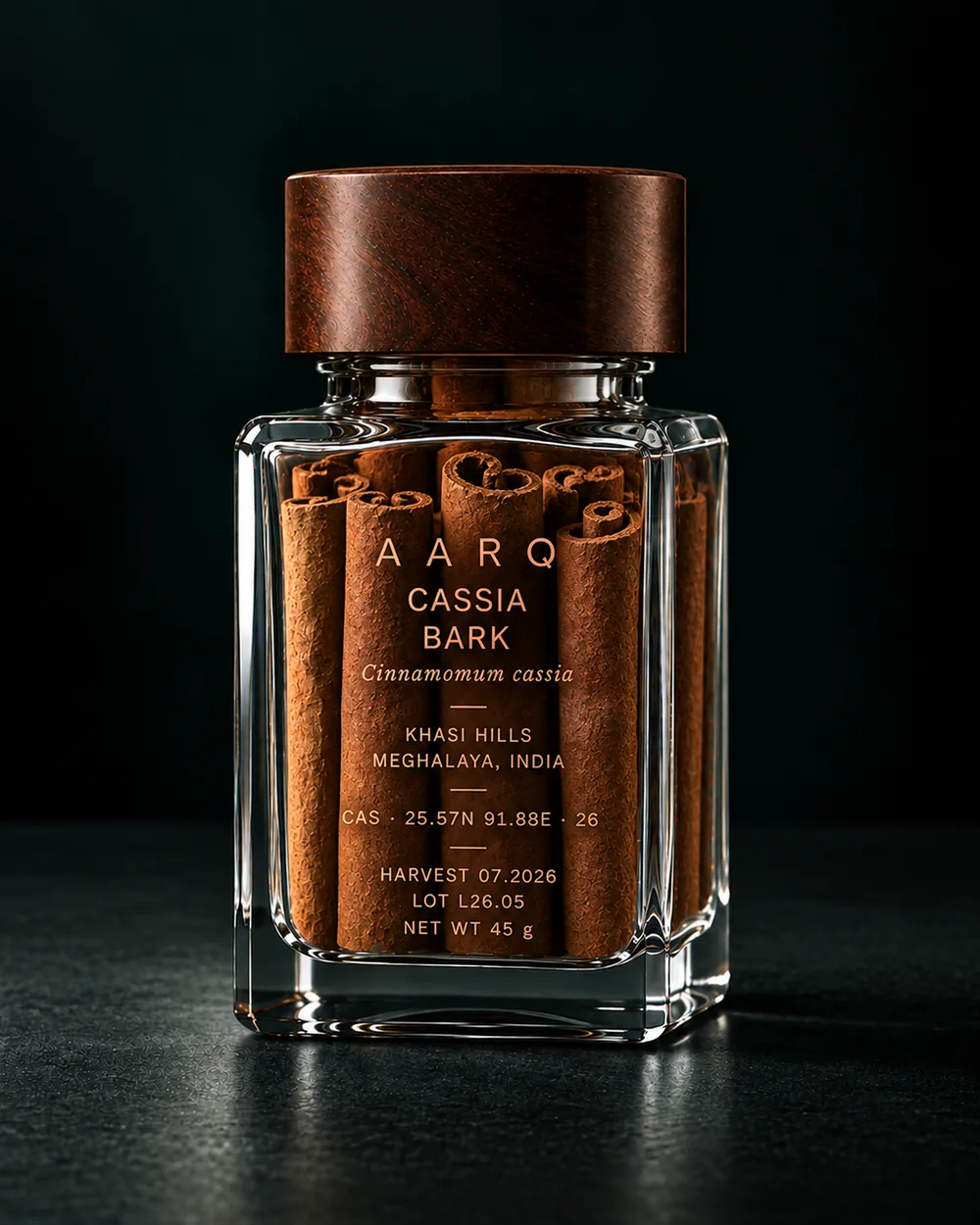
Cassia, not cinnamon. We say so on the jar.
Thick russet bark from the Khasi Hills, rolled into quills as it dries. Cassia is the bolder cousin: darker, more resinous, sweeter on the nose and hotter on the tongue. Hot sweetness, cedar, a trace of clove. It holds its ground in a biryani or a braise where delicate cinnamon would simply disappear.
- Origin
- Khasi Hills, Meghalaya
- Harvest
- 07.2026
- Form
- Whole quills
- Net weight
- 45 g
- On the nose
- Hot sweetness · cedar · clove
One quill into the oil before the onions. Fish it out before serving, or don’t.
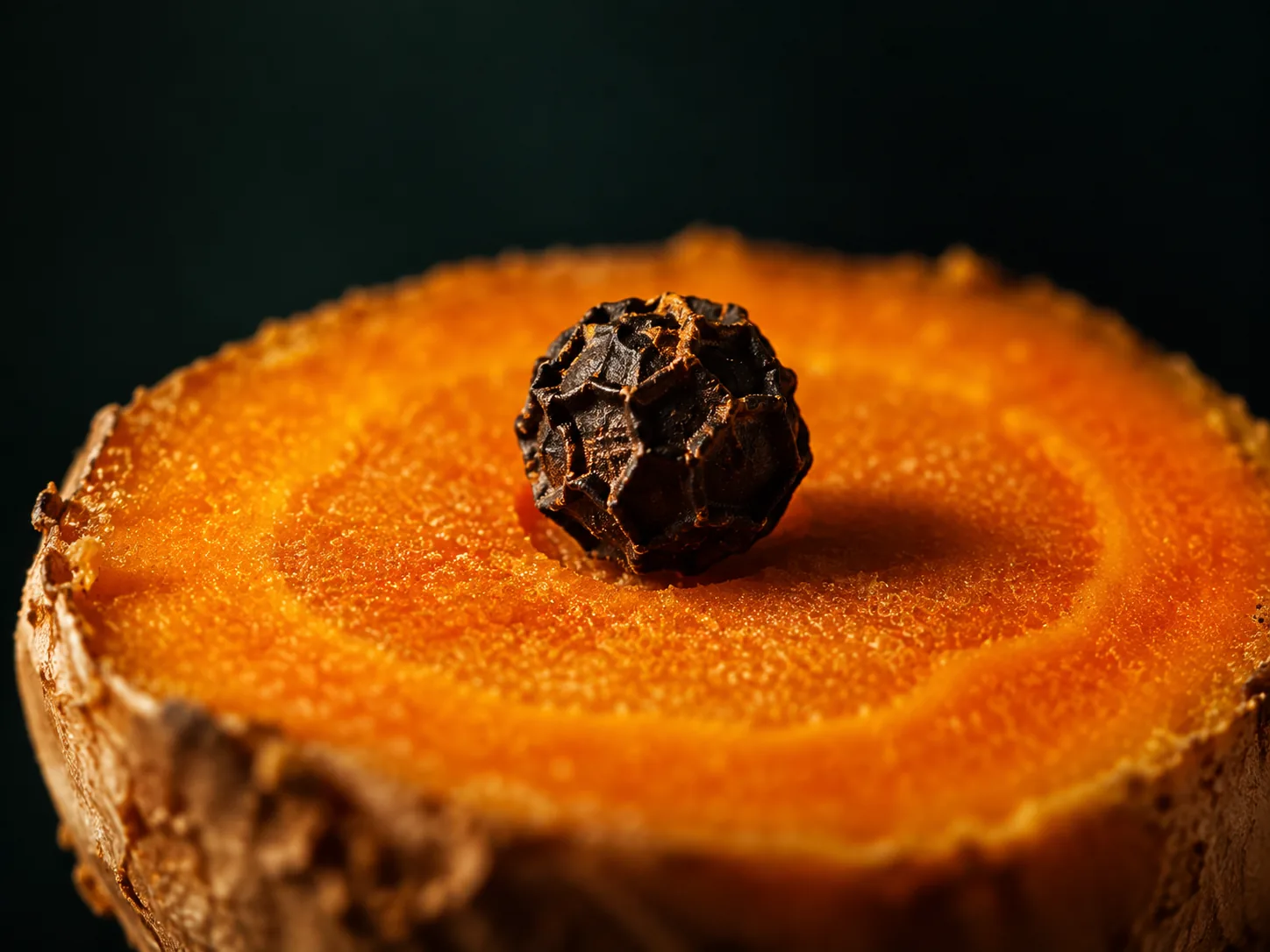
Turmeric and pepper. An old friendship.
Indian kitchens have cooked them together for centuries, long before anyone could say why. The why turns out to be simple: piperine improves curcumin absorption. Which is why these two share a box.
LKG × MBP
Then, something to eat by the handful.
Three dry fruits, held to the same rule as the spices: one grade, one lot, nothing polished, nothing bleached, nothing hidden.
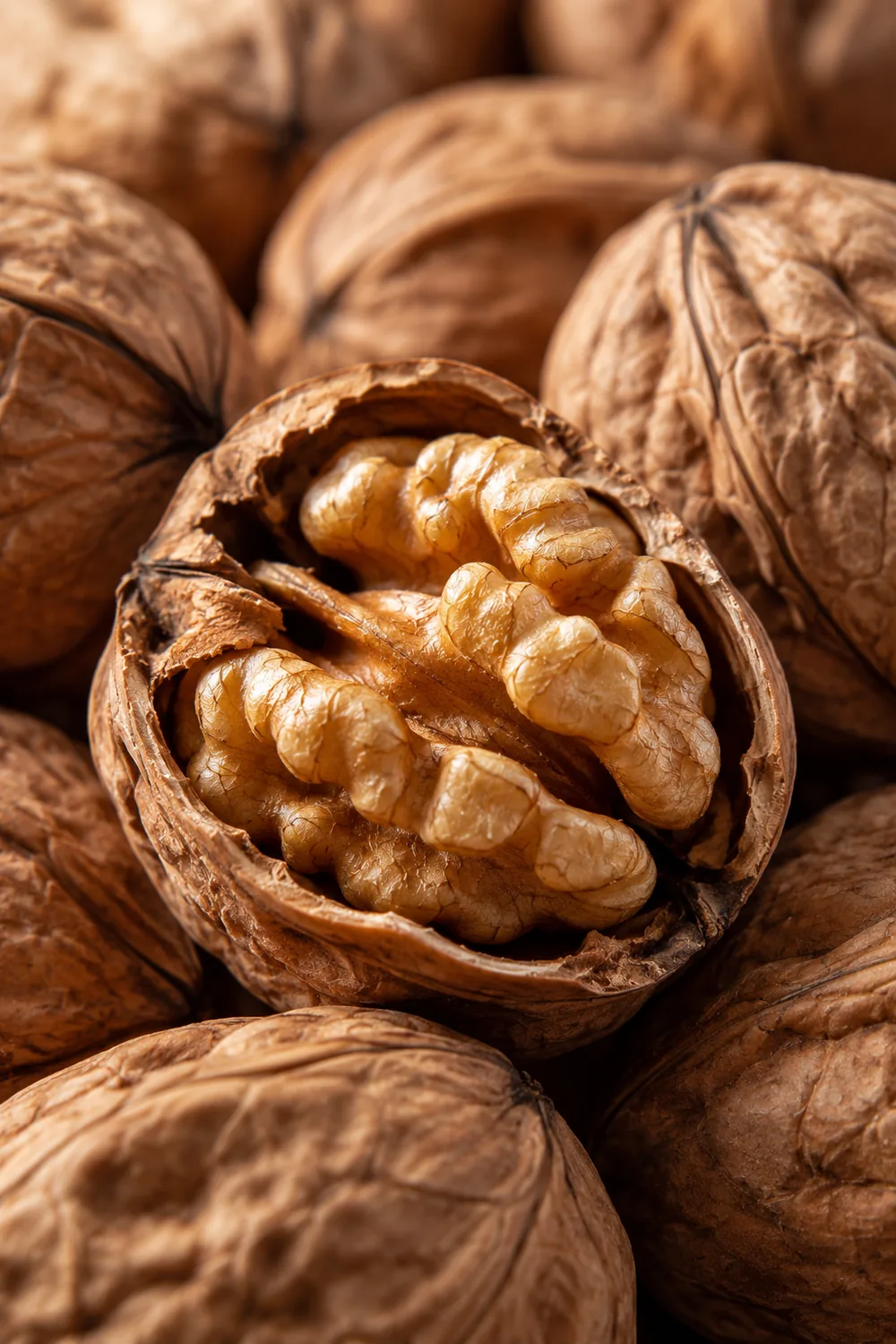
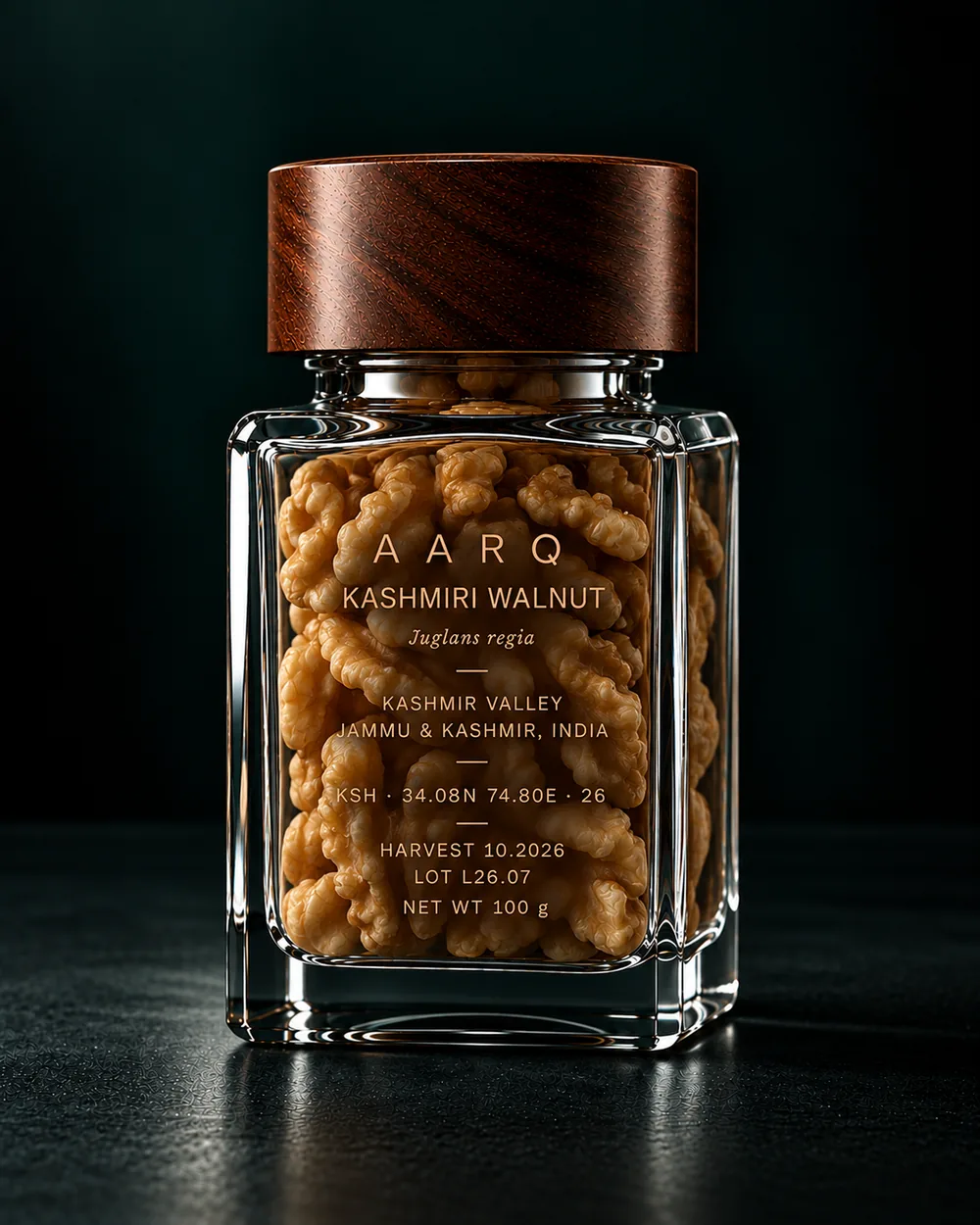
Kashmiri Walnut
Butter first. Then a little bite.
Light-skinned halves from the orchards of the Kashmir Valley, where the trees are shaken in October and the shells are cracked by hand. Kashmiri kernels are rich with oil and quietly sweet, with just enough tannin in the papery skin to keep things interesting. Eat them exactly as they are. They need nothing.
- Origin
- Kashmir Valley, Jammu & Kashmir
- Harvest
- 10.2026
- Form
- Light halves
- Net weight
- 100 g
- On the nose
- Fresh butter · cream · a tannic edge
With a wedge of aged cheese and one slow drip of honey.
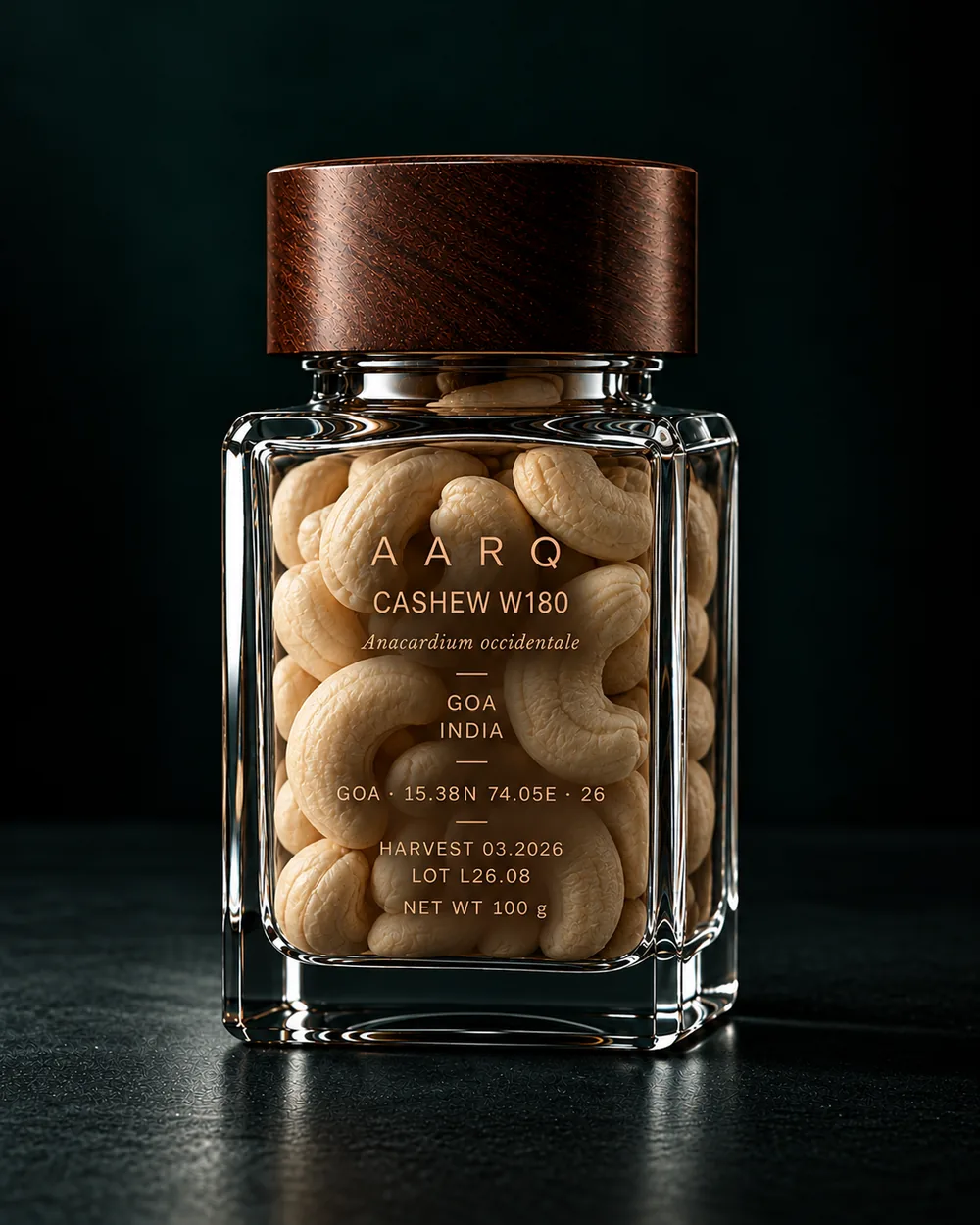
Cashew W180
The king grade.
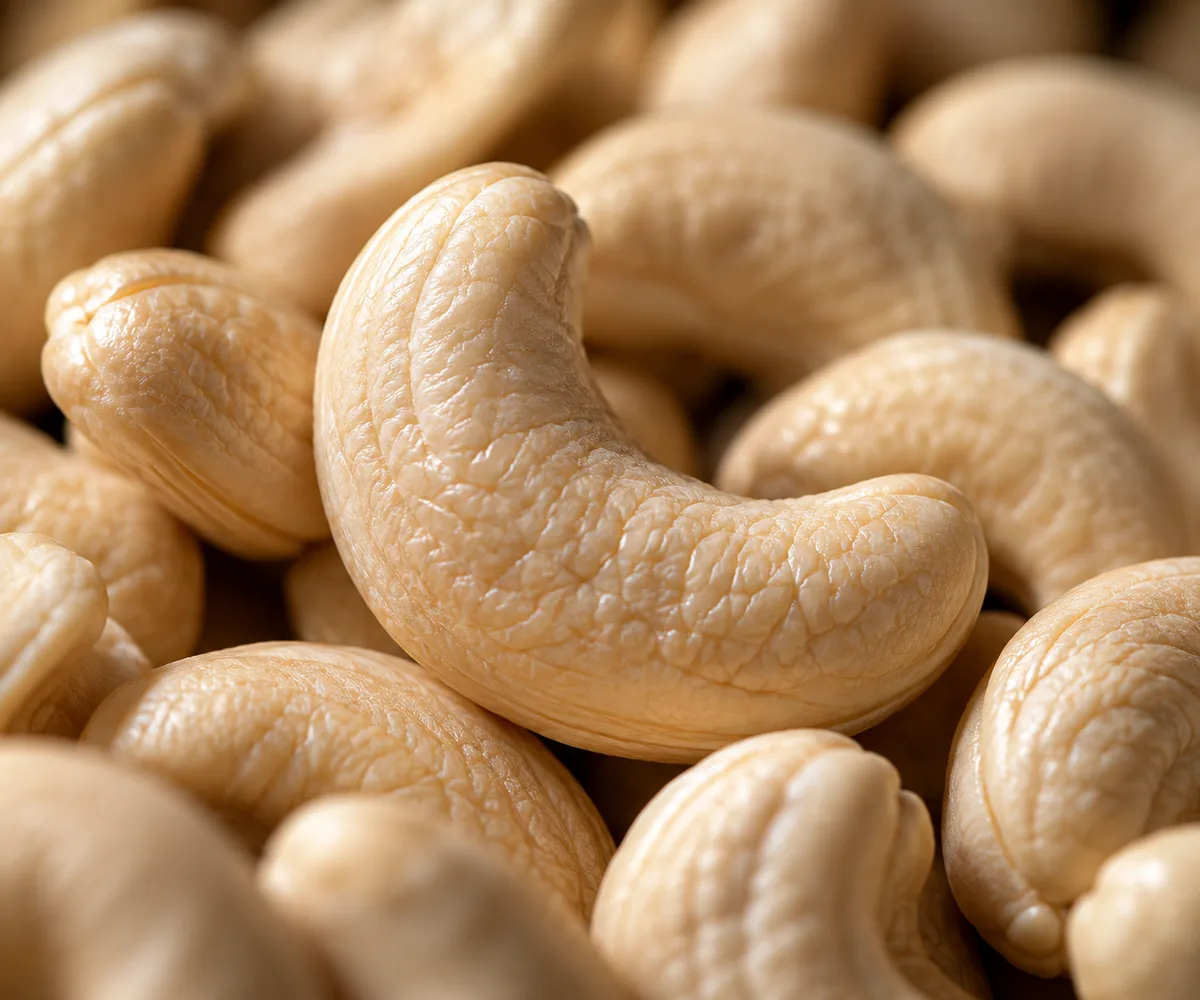
W180 is a count, not a slogan: about a hundred and eighty whole kernels to the pound, the largest grade there is and the hardest to bring through shelling in one piece. Goan cashews are ivory, dense and faintly sweet, with a clean snap and a finish like fresh cream. You will notice the size first. You will remember the texture.
- Origin
- Goa
- Harvest
- 03.2026
- Form
- Whole, W180 grade
- Net weight
- 100 g
- On the nose
- Sweet cream · fresh milk · a clean snap
Toast in a dry pan until the first freckle appears. Salt. Stop.
Mamra Almond
Small, wrinkled and worth it.
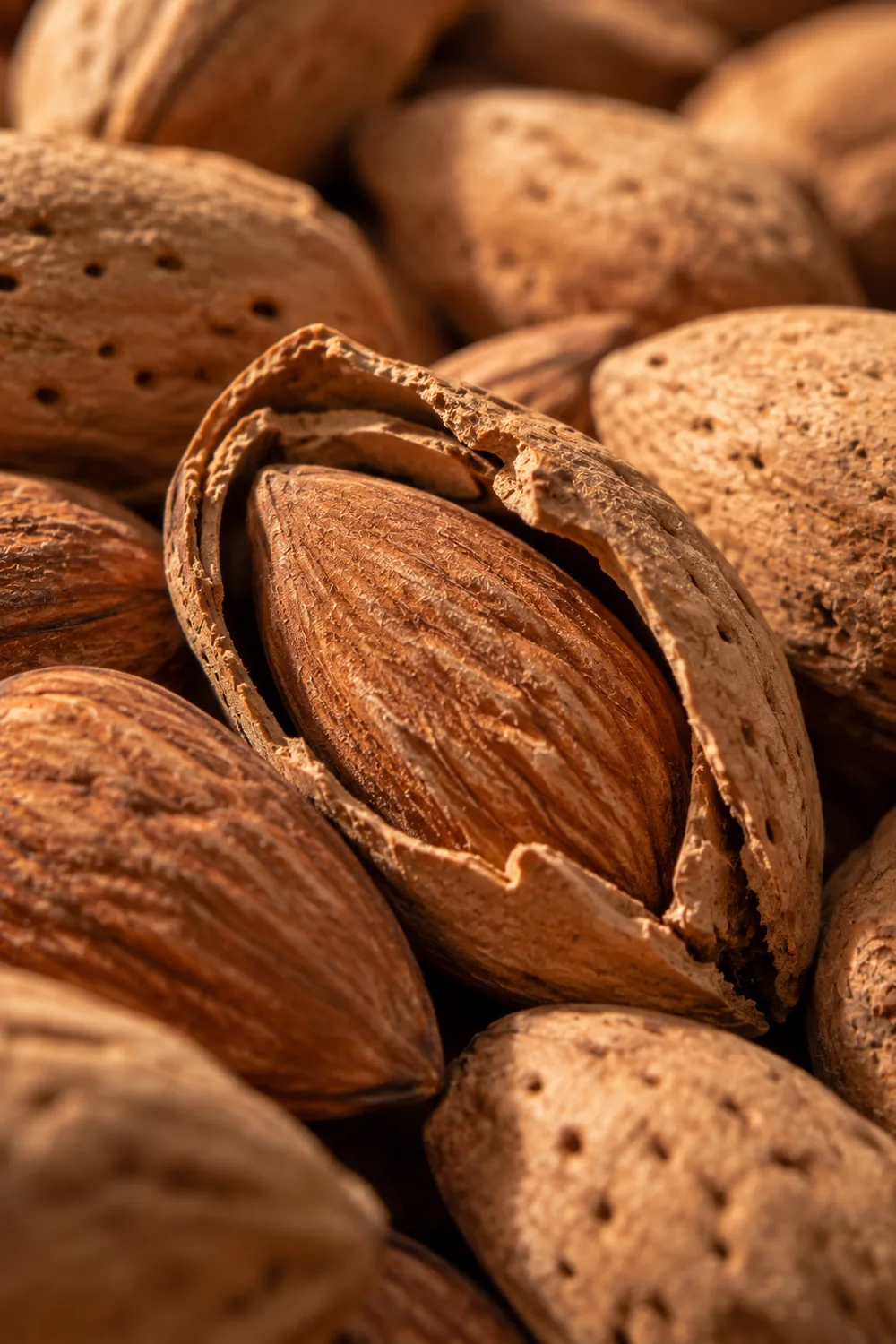
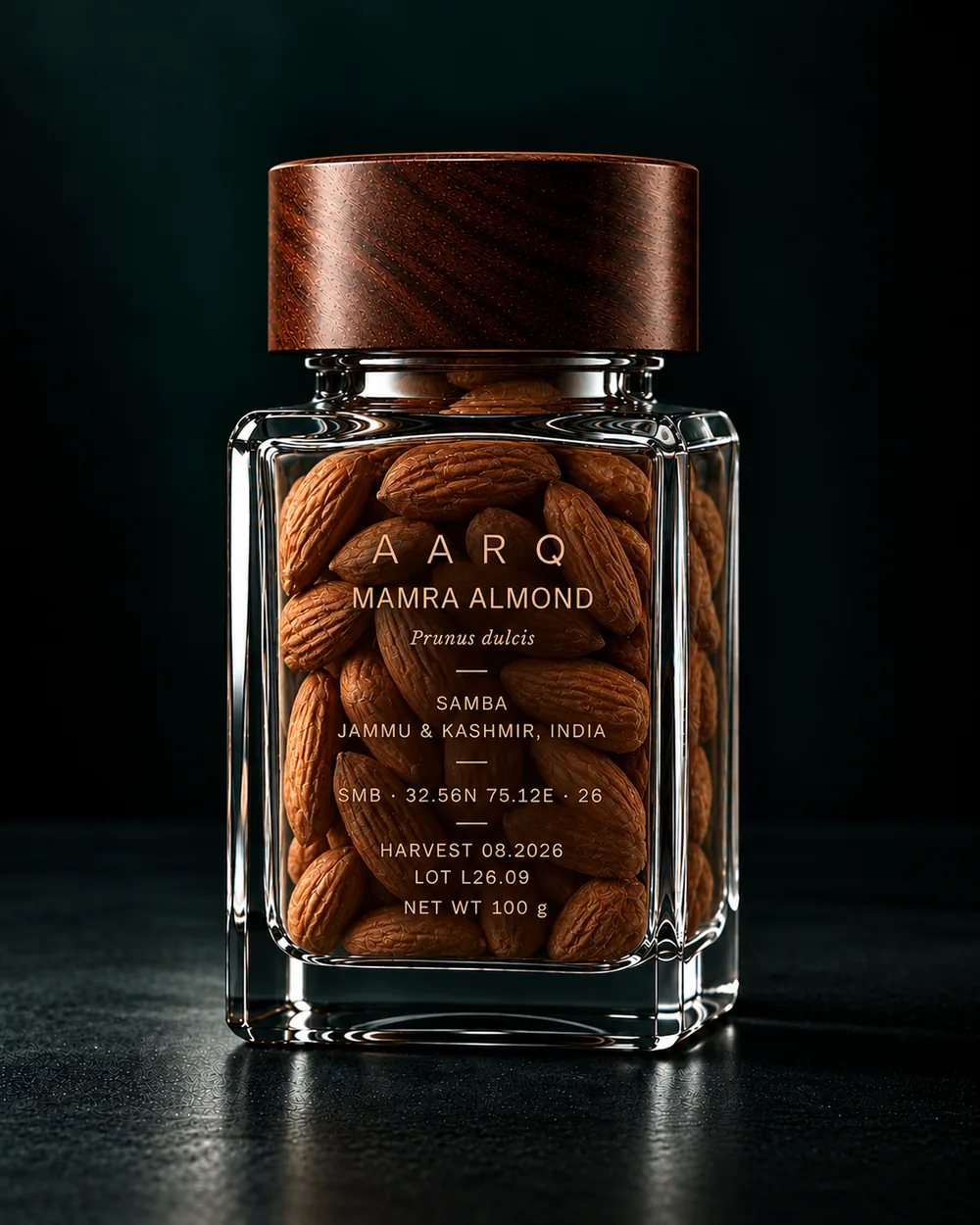
Mamra is the almond that people who know almonds ask for by name. Small, uneven, never blanched, never steamed flat and uniform. The kernel is dense with its own oil, so the flavour runs deeper: marzipan, brown butter, a gentle bitterness right at the edge. It looks nothing like a supermarket almond. That is rather the point.
- Origin
- Mamra grade · packed at Samba, J&K
- Harvest
- 08.2026
- Form
- Whole, skin on
- Net weight
- 100 g
- On the nose
- Marzipan · brown butter · gentle bitterness
Soak seven overnight and peel them in the morning. An old habit, and a good one.
Sourced.
Every jar starts as a place. A hillside that gets too much rain, an orchard shaken by hand in October, a forest garden where pepper climbs whatever tree will have it. We name the place because the place is the flavour.
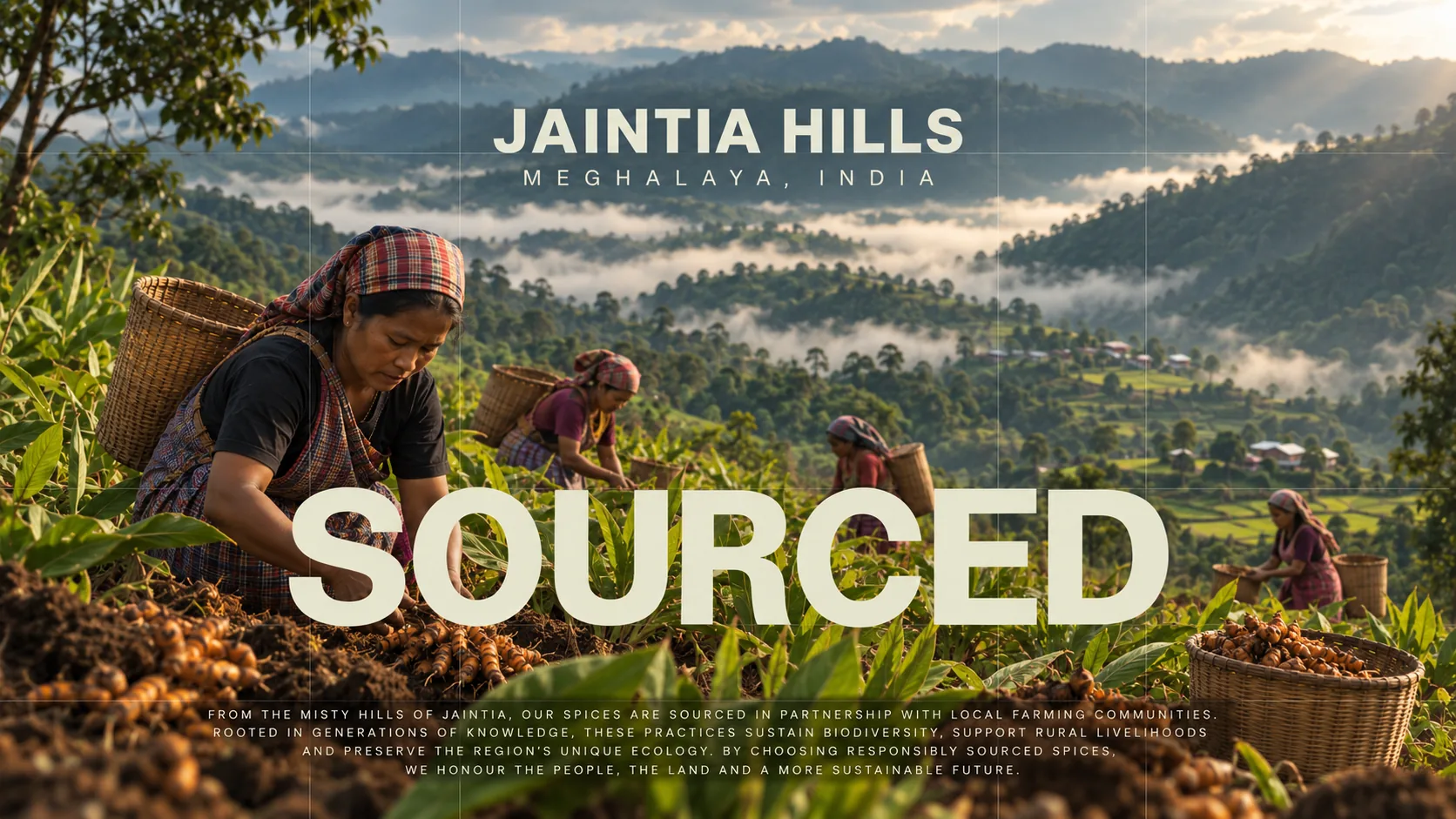
Some of the wettest hills on earth. The turmeric here grows slowly in red soil and comes up small, hard and astonishingly orange.
Lakadong turmeric · 25.53N 92.60E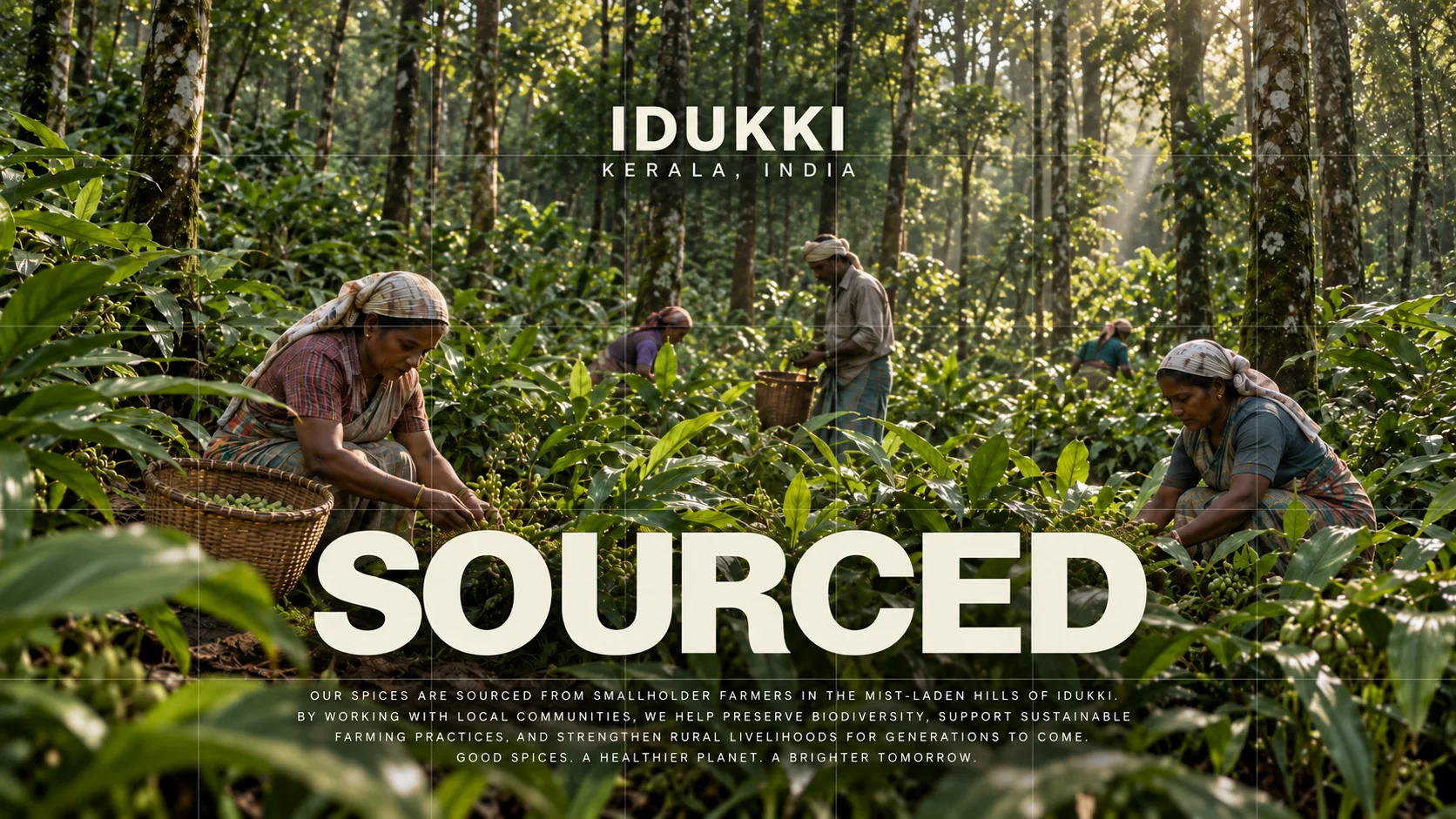
Cardamom grows in the shade, under forest canopy, picked pod by pod every few weeks as each one ripens.
Green cardamom · 9.85N 77.12E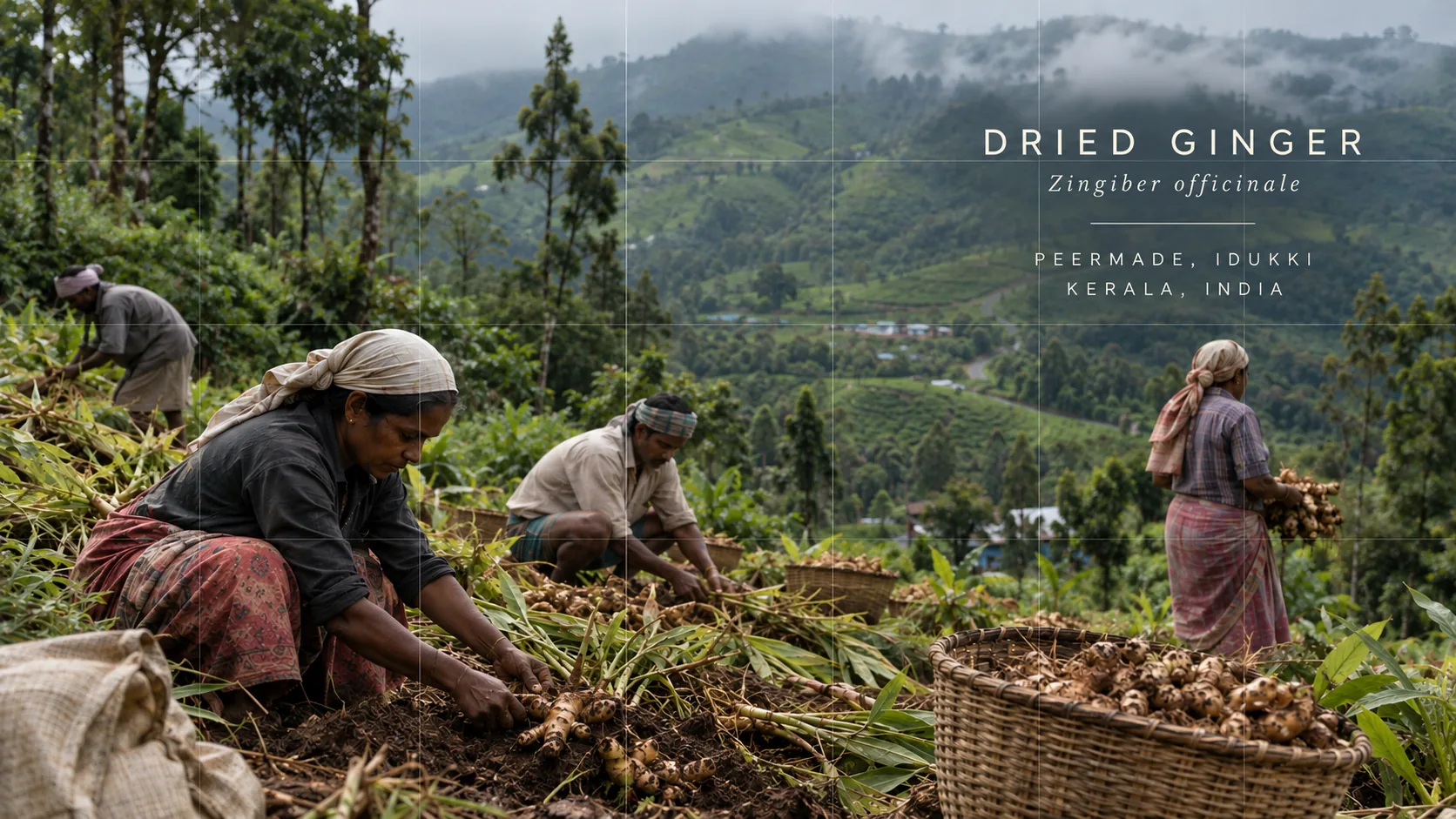
High, cool and misted most mornings. Ginger is lifted by hand in January, then peeled and laid out in the sun.
Dried ginger · 9.58N 76.98E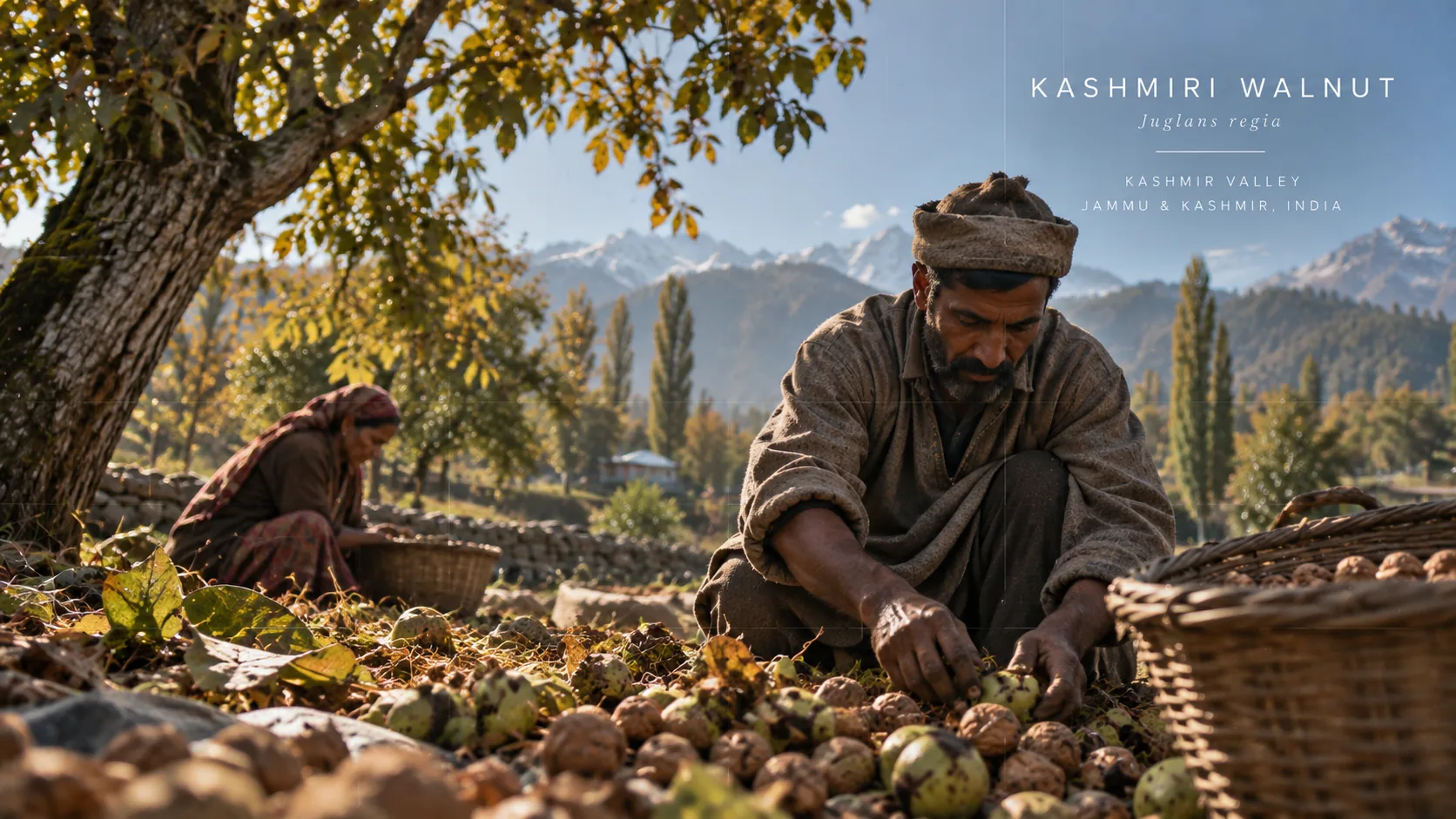
October in the orchards. Long poles, old trees, a carpet of green husks, and the first snow already on the peaks.
Kashmiri walnut · 34.08N 74.80E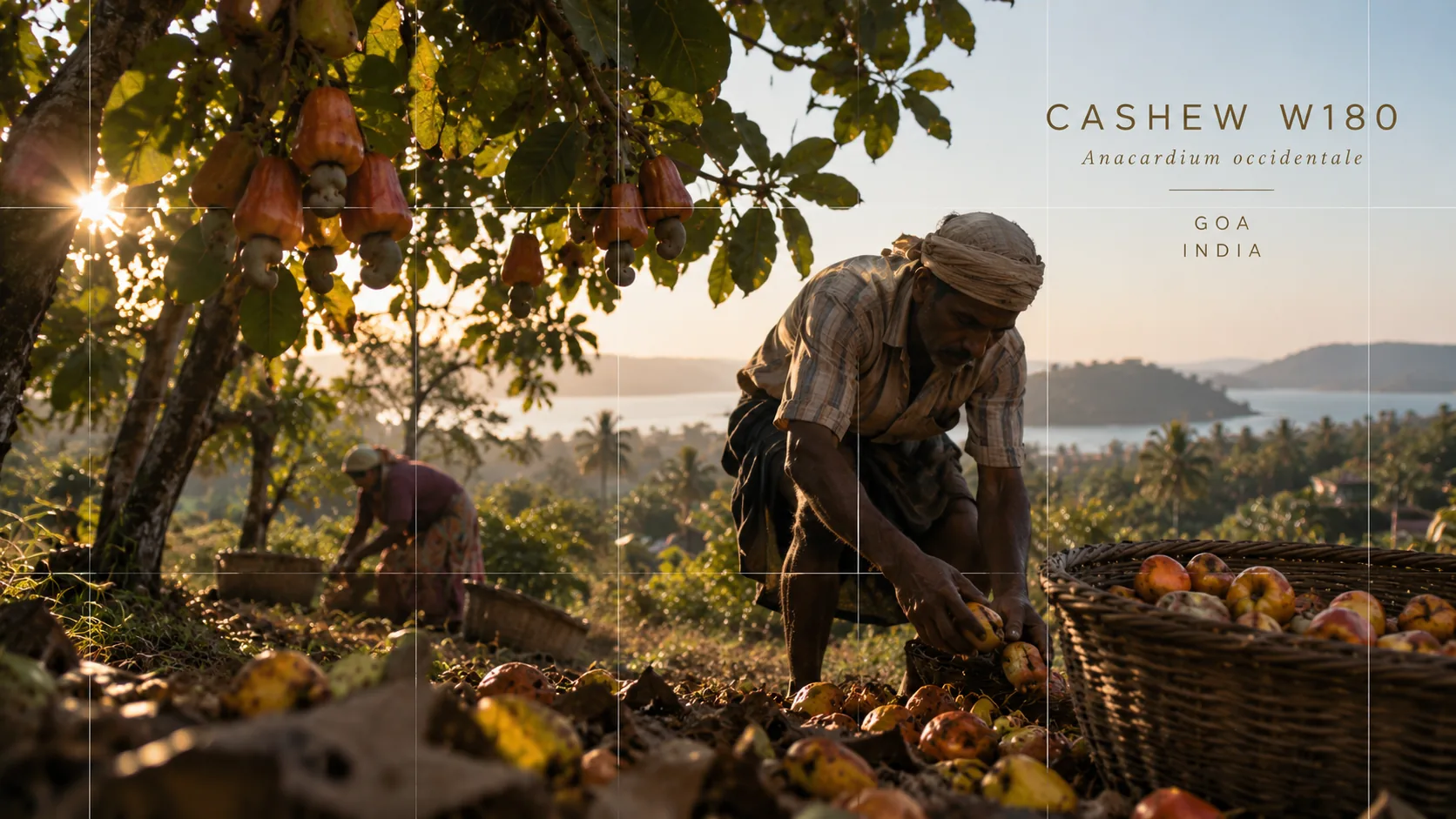
The cashew hangs beneath a bright, astringent apple. It is picked from the ground in the March heat, one at a time.
Cashew W180 · 15.38N 74.05EOne line of type. The whole story.
Every AARQ jar carries a source code on its front. It is not decoration. Tap each part to read it.
Three letters, fixed to the ingredient for life. LKG is Lakadong turmeric and always will be. Find the same three letters on the jar, the case card and the lot record.
Time, held under the lens.
Whatever is worth keeping is worth the wait.
A root waits for its season. A thread waits for its weave. A distillate waits, drop by drop, over the flame.
Whatever is worth trusting is worth the proof.
Every claim is questioned. Every answer is written down. Every batch is held to the light.
AARQ lives between the two — patience on one side of the glass, scrutiny on the other. Only what passes through both carries our name.
Arq is an old word for a distillate: what remains when all else has been drawn away. Our mark holds the same idea — an hourglass inside a lens, and at its centre, one grain. Held.
Foil-stamped on the cap of every jar · engraved on the plate of the trunk
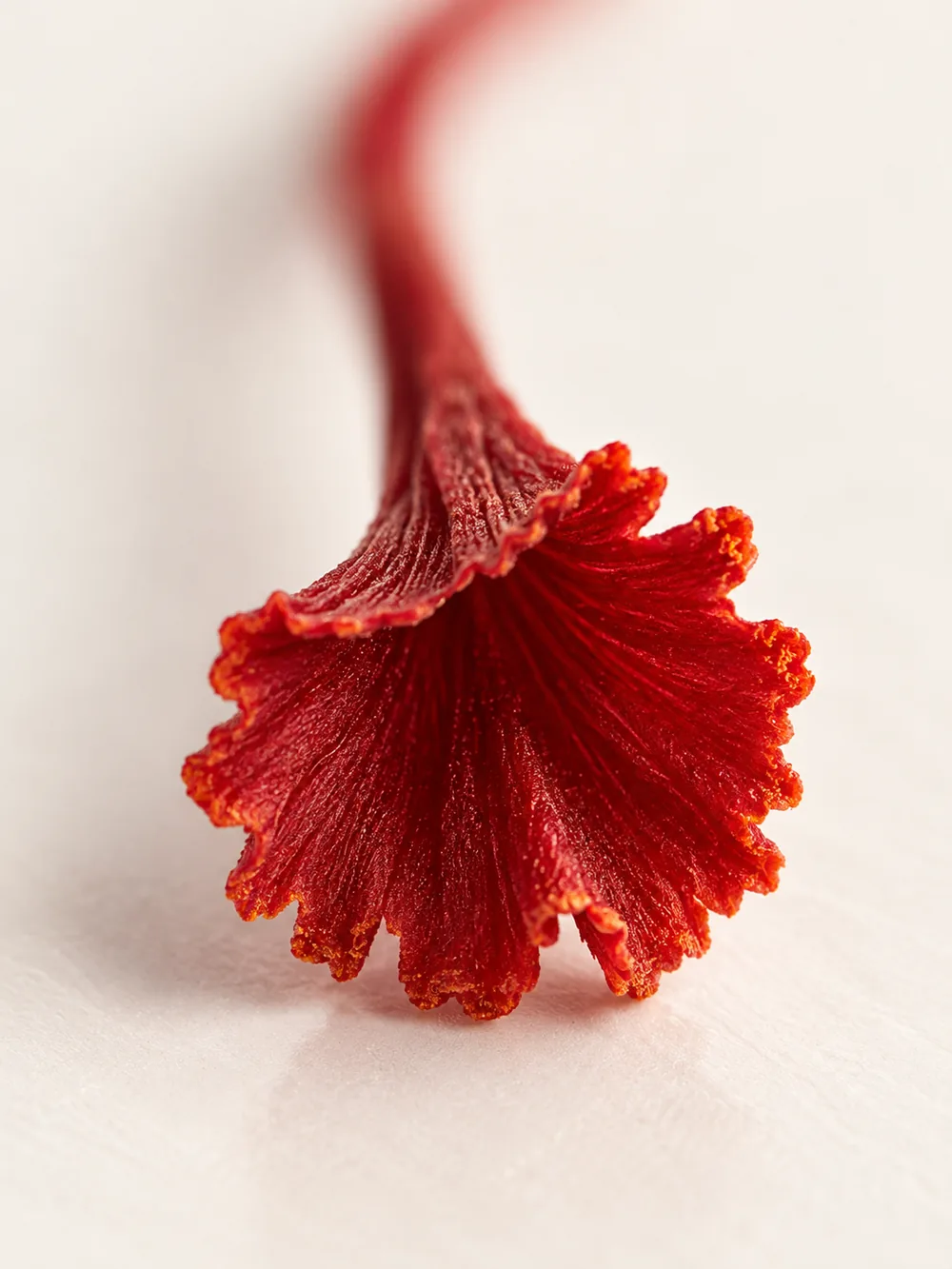
Saffron. One thread at a time.
Each crocus gives three threads and one morning to pick them. The Reserve will be small, numbered and late, because saffron does not hurry for anyone. Ask, and we will tell you when it is ready.